From Our Archives
For earlier essays on this week's RCL texts, see Amy Frykholm, Wrestling with the Unknown (2025); Michael Fitzpatrick, Transfiguring the Senses to Perceive Christ’s Majesty (2023); Debie Thomas, The Limp and the Blessing (2020); and Dan Clendenin, He Felt Compassion (2017) and The Nation of Israel as the People of God (2014).
This Week's Essay
By Amy Frykholm, who writes the lectionary essay every week for JWJ.
Matthew 14:17: “We have nothing here but five loaves and two fish.”
For Sunday August 2, 2026
Lectionary Readings (Revised Common Lectionary, Year A)
Psalm 17:1–7, 15 or Psalm 145:8–9, 14–21
Romans 9:1–5
Matthew 14:13–21
I start a large number of these essays in the same place: at the Community Meal and Food Pantry at my church, St. George Episcopal Mission in Leadville, Colorado. The Community Meal and Food Pantry is a 30 year-old food sharing operation that now runs six days a week. It involves both hot lunches and food distributions. I've been a cook there for 25 years, and it has been the ground for almost all of my learning about the spiritual life. At St. George we’ve long understood that there is a connection between the communion table and the community meal table. We know that the rituals of one feed the rituals of the other, and that both are about the real presence of Christ. But we don’t always grasp all of the implications of these connections, and every day seems to present a new challenge in how to live out that understanding.
One of the hardest lessons of the Community Meal and Food Pantry — the one we’ve spent more hours agonizing over, that has upended more relationships, worn out more volunteers, given us more sleepless nights — is the lesson of enough.
What is enough? When do we have enough? How do we communicate the concept of enough to the people who join us for food pantries and meals? How do we answer our own dark fears about not having enough? How do we trust?
Eventually — and this took decades of careful observation — I noticed that we spent almost all of our mental energy worrying about money we wouldn’t have in the future, grants we wouldn’t receive, the bank account that our calculations said would soon run empty. Almost every committee meeting centered around these concerns, which were perfectly justifiable. It was our job to make sure things ran smoothly. People depended on our food sharing to meet their basic needs, after all. This was not a task we could take lightly. So often, our orientation defaulted to: not enough.
 |
|
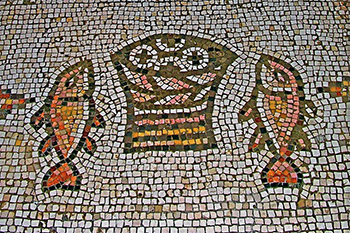
Church of the Multiplication, Loaves and Fishes Mosaic (circa 4th c.). |
Yet at the same time, we were spending almost all of our physical energy trying to deal with the overwhelming abundance that constituted our daily lives: the 400 butternut squashes coming in at the end of the season. The 40 boxes of grapefruit donated from the state-wide food bank. Having to send an extra car over to the superstore to collect more food than one car could manage. The overflowing freezers. One day, I arrived to cook the meal, and found the walk-in cooler packed so full that I could only extract one package of sausage and a small box of vegetables without making the whole tower fall over. In an odd irony, I almost didn’t have enough to cook with because we had too much food to deal with.
Yet somehow, we almost never set our present abundance in relationship to our fear of the future. These two conversations remain entirely separate.
One day we had around 100 half-gallons of ice cream donated: a freezer had gone out at the local grocery store. We didn’t have freezer space for even ten of these containers. I needed to get rid of ice cream, and I needed to get rid of it fast. Yet I knew that this kind of sudden abundance would spread anxiety through the crowd. Many people would want to grab as much ice cream as they possibly could. Others would point at the grabbers and complain that it was unfair. Every single one of us could take a spoon and a half gallon of ice cream and sit outside and eat until our stomachs hurt if we wanted to. People could gorge or hoard to their hearts’ content. And yet I knew that an overwhelming abundance of ice cream was likely to create more anxiety than no ice cream at all. We all have a way of viewing abundance through the lens of habitual, usually imagined, depravation.
Part of me wanted to come up with a fair and rigid system. Everyone will get two containers of ice cream. I will stand at the front and dole out the ice cream to ensure fairness. But I knew that this would put me in the role of ice cream police. Trying to manage the ice cream would create cheaters and tattle-tales. Some people had households of 20 and some had households of one. A system of two containers each was not likely to be more fair than grab as grab can. There was no way I could catch everything that was happening. And anyway, I had a lot of other things to do — like make a meal for 50 people.
 |
|
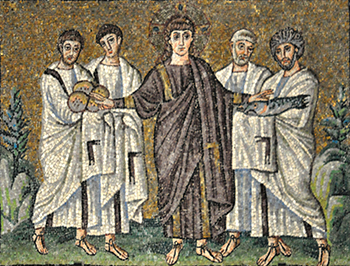
Church of Sant’Apollinare Nuovo, The Miracle of the Loaves and the Fishes (6th c.). |
That day’s solution came to me in a moment of inspiration. I climbed up on a stool and said to the assembled crowd who was eying the ice cream, “Please take all the ice cream you want and none of the ice cream you don’t. There is no way that I can do that calculation for you. Only you know if you are a one half-gallon kind of person or a ten half-gallon kind of person. There is more than enough ice cream here for everyone, if everyone will just take what you actually want and leave what you don’t. And pay attention to the others around you. Think about what they might want as well as what you want.”
The gathered participants looked at me like I was completely nuts. I climbed down from my stool, went back to the kitchen, and started working on the meal. Before noon, the ice cream was gone. I heard no complaints and we had no storage problems.
This is the practice that we are in daily, and not just at the Community Meal and Food Pantry: how do we live between divine outpouring — crazy abundance — and our deeply rooted and human fear that we won’t be taken care of, that our needs won’t be met?
Matthew sets the feeding of the 5000 in a painful context. It’s tempting to look at it as a story of ease and light, as Jesus makes an extravagant demonstration of divine abundance and divine compassion. But instead, the context is the beheading of Jesus’ friend, cousin, companion, perhaps even mentor, John. After Jesus learns that John has been killed, he goes off in a boat to be alone. We can ascribe a number of motivations to this retreat: grief, fear, preparation for the dark road he himself will follow. Matthew leaves this to his reader’s own imagination.
 |
|
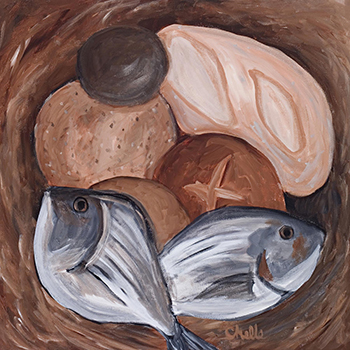
Chelle Fazal, Loaves and Fishes (2010). |
But when Jesus comes back, he sees a crowd that has gone looking for him as they too have learned of John’s death. It gets late, there is nowhere to get food, and the disciples think it’s probably time to wrap things up. They are thinking in practical terms: the people should go back to the villages so that they can get some food before the shops close. But their understanding is very much located in a perception that there is not enough: there isn’t enough time for people to get back to the villages; there isn’t enough food here; people will go hungry.
Jesus is thinking in far different terms, motivated by his compassion for the people and his understanding of divine abundance, as well as the practical and important problem of what the people will eat.
Following the pattern that becomes the ritual for the last supper and the ritual for our own communion tables over the centuries, Jesus takes the five loaves and the two fish and looks up. He blesses the food and breaks the loaves. The disciples take this food into the crowd and discover that even after everyone — more than 5,000 people — has eaten, there are still 12 baskets left.
I don’t know if there is any lesson harder for us at this particular moment in history than this one: at the darkest times, our work is not to listen to our fears and act appropriately, but to respond to divine abundance and act extravagantly.
Weekly Prayer
Mary Oliver (1935–2019)
Why worry about the loaves and fishes?
If you say the right words, the wine expands.
If you say them with love
and the felt ferocity of that love
and the felt necessity of that love,
the fish explode into many.
Imagine him, speaking,
and don’t worry about what is reality,
or what is plain, or what is mysterious.
If you were there, it was all those things.
If you can imagine it, it is all those things.
Eat, drink, be happy.
Accept the miracle.
Accept, too, each spoken word
spoken with love.Mary Jane Oliver (1935–2019) was an American poet who won the National Book Award (1992) and the Pulitzer Prize (1984). This poem can be found in Oliver’s collection Devotions (Penguin, 2017).
Amy Frykholm: amy@journeywithjesus.net
Image credits: (1) Fine Art America; (2) Christian Iconography; and (3) Fine Art America.