From Our Archives
For earlier essays on this week's RCL texts, see Michael Fitzpatrick, Mercy On All (2023); Debie Thomas, Is It Good News Yet? (2020); Dan Clendenin, Send Her Away! (2017) and God's Mercy On Us All (2014).
This Week's Essay
By Amy Frykholm, who writes the lectionary essay every week for JWJ.
Isaiah 56:7: “My house shall be called a house of prayer for all peoples."
For Sunday August 16, 2026
Lectionary Readings (Revised Common Lectionary, Year A)
Psalm 133 or Psalm 67
Romans 11:1–2a, 29–32
Matthew 15: (10–20), 21–28
Last year our dog, Kubi, an eight year-old mini-Australian shepherd mix, disappeared in the vast, historic mining district near our house. After hours of searching, by sheer luck we chanced to look down into a forty-foot sinkhole, and there he was at the bottom, apparently unhurt, but definitely trapped.
After assessing our immediate options, we called the local Search and Rescue group—a volunteer organization that provides emergency assistance in the wilderness near our town. We weren’t sure they would be willing to rescue a dog, but we also weren’t equipped to descend the precarious wall of the sinkhole ourselves.
Within 30 minutes, a team of rescuers had assembled, and they began creating the most elaborate “high line” rescue setup known to humankind. It involved several trees, dozens of ropes, a dog kennel, and cords tied in such a way that they could open or close the kennel door without anyone having to go anywhere near the collapsing edge of the hole. They planned to lower the kennel, attract Kubi into it, and then pull the kennel up using the many pulleys they had attached. We watched in awe while this team applied its expertise to this project. I felt humbled by their care, their precision, and their attention.
But the high line took a long time to put together; it was growing dark and a rain storm was coming in. Just when the team was about to launch their apparatus with peanut butter and warmed-up chicken baiting the kennel, a phone rang. It was the sheriff. “I’m calling it off up there. It’s too dangerous. We aren’t going to risk people for a dog,” he said. One of the team leaders took the phone into the woods to talk to the sheriff in private and explain the situation, the precautions, the ever-tighter timeline.
 |
|
Ilyas Basim Khuri Bazzi Rahib, Jesus and the Canaanite Woman (1684).
|
“I need 20 minutes to think about this,” the sheriff said, and hung up. So in the growing gloom, listening to thunder rumble in the distance, we waited. When the sheriff called back, he said, “You can go ahead, but only until dark. And if it starts raining, you’re done.”
The team lowered the kennel. Kubi took a few steps toward it (as far as we could tell from the commentary, because we weren’t allowed anywhere near the hole). But then it started to rain. The team quit for the night. One of the leaders took us aside and said, “Look. Your dog is healthy. He might have a miserable night, but he isn’t going to die. We’ll be back first thing in the morning. Whatever you do, please do not go down into that pit.”
What followed was one of the most miserable nights of our lives. We stayed awake trying to figure out what to do if the Search and Rescue team’s plan failed or if the sheriff wouldn’t allow the rescue to continue. We worried the sinkhole would continue collapsing in the rain. We worried about our wet and lonely dog at the bottom of a pit with perhaps no idea how determined we were to get him out.
Before dawn, we went back to where Kubi was. We half hoped he’d spent the night in the kennel the team had left for him and we could quietly close the doors (using the special cords). Then when the Search and Rescue team returned, they would only have to pull him up. But no such luck.
After checking the hole and confirming that Kubi had lived through the night, we went back to our car to get a fishing pole that we had brought in order to lower water into the pit, planning for a long, difficult day. When we got to the road, we heard the churn of tires on gravel, and we knew: the Search and Rescue team was coming up the road. In fact, the whole team was back, and they’d also been up all night trying to think about how to get Kubi out and had arrived with new ideas, new treats, and new energy.
 |
|
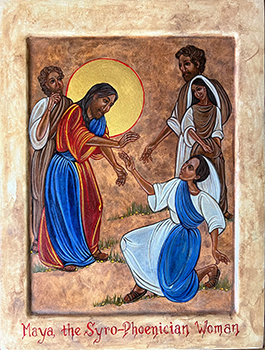
Anonymous, The Syrophoenician Woman.
|
Within half an hour, the rescue was complete. They used the fishing pole to lure Kubi into the kennel with a hot dog attached to the end. They closed the door, pulled the kennel to the top, and there was our little guy — wet and cold and terrified, but unhurt.
We knew there were a lot of questions among Search and Rescue members about the use of their resources to rescue dogs. Ours wasn’t the first call for a dog rescue that month, and the sheriff had been alerted to the dog rescue by a disgruntled member who didn’t think that the team should say yes to these kinds of requests. At the same time, other members of the team told us they believed that when you rescue a dog, you likely prevent the rescue of a human, because the human will go to extreme (and often ill-advised) measures to try to save their beloved animal. And they were quite obviously thrilled by the opportunity to practice their rope rescue skills. For some it was a win-win-win (humans, rescuers, dogs), but for others, it was part of a bigger question: Who is worthy of our resources?
In this week’s lectionary, Jesus encounters the Syro-Phoenician woman, and he calls her a dog. This is not a pretty story, and there aren’t nice ways to tell it. The first part of Matthew 15 tells us that Jesus is in the midst of a reordering of the rules and their meanings in his own context. He is in conflict with his own people about the meaning of purity. Who gets to claim it? Is it a matter of the heart, the mouth, the stomach? But he hasn’t yet, apparently, looked at how deep the matter of exclusion goes inside of himself.
In the district of Tyre and Sidon, a Syrophoenician woman shouts at him, “Have mercy on me, Lord, Son of David; my daughter is tormented by a demon” (Matthew 15:22). Jesus doesn’t bother to answer her, and the disciples want to send her away. Jesus seems to agree with their assessment. “I was sent only to the lost sheep of the house of Israel,” he says (15:24).
 |
|
Br. Robert Lentz, OFM, The Syrophoenician Woman.
|
But she persists, and when she makes her way to Jesus, he calls her and her daughter “dogs” to her face. He says, “It is not fair to take the children’s food and throw it to dogs” (Matthew 15:26). It’s a shocking line. On the surface, it seems ignorant, exclusive, meant to dismiss and demean.
But the woman enters into Jesus’ own logic to teach him the meaning of his own tradition. She doesn’t argue that she is not a dog (although I wish she would). She doesn’t turn away hurt, offended, and disappointed. The matter is too important for her to worry about her feelings. She says, “Yes, Lord, yet even the dogs eat the crumbs that fall from their masters’ table” (15:27). Even dogs are included.
These words have a profound effect on Jesus. It’s as if he suddenly remembers the words of Isaiah that are recalled in this week’s lectionary. “Thus says the Lord God, who gathers the outcasts of Israel: I will gather others to them besides those already gathered” (Isaiah 56:8). Jesus’ “only” in verse 24 is completely repudiated in verse 28 by the word “others.”
If we look at how this story sits in the Gospel of Matthew, known as the “teaching Gospel,” we can see how Matthew leads his readers along a path of understanding as we watch Jesus being led. This story is a key milestone in an ever-expanding vision that begins in Matthew 8 when Jesus says of the centurion, “I have not found such great faith with anyone in Israel” (8:10). While a light seems to go on for Jesus in this verse, he still tells the disciples in Matthew 10 not to “go among the Gentiles or enter any town of the Samaritans.” But Jesus’ vision keeps expanding, and by Matthew 28, the resurrected Jesus amends his instructions to the disciples and tells them to go out to all the nations. Just how wide is this vision? It includes all.
This is a journey that Matthew wants us to take with Jesus, to learn as he learns: this healing, this power, this divine realm doesn’t belong only to you; neither are you separate from it. The dominion of love is wider than any person, any community, any nation. We have reason to believe, as Paul Simon sings, we all will be received in Graceland.
Weekly Prayer
Abraham Joshua Heschel (1907-1972)
From word to word I roam, from dawn to dusk.
Dream in, dream out -- I pass myself and towns,
A human satellite.
I wait, am hopeful, as one who waits at the rock
For the spring to well forth and ever well on.
I feel as bright as if I tented somewhere in the Milky Way.
To urge the world to feel I walk through lonesome solitudes.
All around me lightning explodes sparks from my glance
To reveal all light, unveil faces everywhere.
Godward, onward to the final weighing
overcoming heavy weight with thirst.
Constantly, the longings of all born call out, "Is anyone around?"
I know each one is HE, but in my heart there writhes a tear;
When of men and rocks and trees I hear;
All plead "Feel us"
All beg "See us"
God! Lend me your eyes!
I came to be, to sow the seed of sight in the world,
To unmask the God who disguised Himself as world--
And yes, I wait to be the first to announce "The Dawn."Translated by Rabbi Zalman M. Schachter-Shalomi
Abraham Joshua Heschel (1907-1972), a Polish-American rabbi, was one of the most prominent Jewish theologians of the 20th century. He was a foremost leader of the Civil Rights Movement. He was influenced deeply by Hassidic, medieval Jewish philosophy, and Kabbalah. This poem is a selection from "Human, God's Ineffable Name.” Available from the Reb Zalman Legacy Project.
Amy Frykholm: amy@journeywithjesus.net
Image credits: (1) Patheos; (2) Modern Icons; and (3) St. Brendan's Anglican Church, Maryville, Tennessee USA.