From Our Archives
For earlier essays on this week's RCL texts, see Michael Fitzpatrick, There is No Distinction (2023); Debie Thomas, Out on the Water (2020); Dan Clendenin, God Meant it for Good (2017) and Listening for God's Love (2014).
This Week's Essay
By Amy Frykholm, who writes the lectionary essay every week for JWJ.
Psalm 85:11: “Truth springs up from the ground.”
For Sunday August 9, 2026
Lectionary Readings (Revised Common Lectionary, Year A)
Psalm 105:1–6, 16–22, 45b or Psalm 85:8–13
Romans 10:5–15
Matthew 14:22–33
I was in my first semester of graduate school, in a class called “Theology and Language,” when I had an encounter with a professor that chased me away from the Bible for decades.
I was excited about this class. It seemed to me that those two terms — theology and language — were at the heart of what I’d come to graduate school to understand, along with a third term culture. I wanted to understand how language about God was shaped by cultural forces and how that shaping formed our capacities for theological thinking. At least that’s what I thought I wanted. I was influenced by Paul Celan and his writings on the Holocaust and haunted by his phrase that language about God must “pass through the thousand darknesses of death-bringing speech” in order to once again be meaningfully spoken in our own time.
In other words, I had a lot of questions, and I naively thought that graduate school was the place to explore them. Then one day, I was in class — I remember the smell of the room, the dust motes, the light through the Gothic windows. I remember exactly where I was sitting in the circle of old fashioned desks: midway around the seminar’s half circle. But I don’t remember what I said to prompt the professor’s sudden and vehement response to me. He pointed at me and shouted, “You’re the sort of person who wants to tear pages out of the Bible!”
I was shocked. Only at that moment did I notice that I was one of only a handful of women in the room, that all eyes were now trained on me, and that if given a choice between fight, flight, or freeze, I was definitely a freeze-type person. I felt viscerally attacked, and I could feel shame creeping to the surface as my most conditioned response to being called out by someone in a position of authority.
I believe that I said maybe too quietly, “I am not that sort of person at all. I just want to reserve the right to ask questions about it.”
 |
|
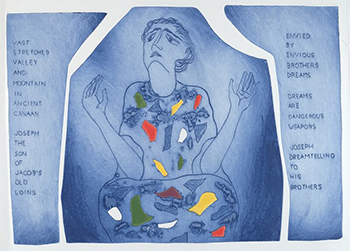
Peter Lipman-Wulf, Joseph and His Brothers II (1966).
|
But the professor’s words had done their damage. From that moment, I learned that my questions were not welcome in that class and that I would have to go elsewhere to explore them. But even more, this encounter led me to wonder if I really wanted anything to do with the Bible after all. Maybe the Bible belonged to him and his “orthodox” views. Maybe there wasn’t a place for me or if there was a place, I would have to fight for it, and I wasn’t especially interested in doing that. I wish I could say that I spent the next twelve weeks arguing with that professor, but I went underground instead, placidly turned in my assignments so as not to attract any more unwanted attention, and counted the days until I was free of him — and also, to some degree, of the Bible.
I thought of this encounter recently when a friend passed along Megan Phelps-Roper’s new podcast “Book Keeper.” Phelps-Roper was raised in Topeka, Kansas, the granddaughter of Westboro Baptist Church’s infamous pastor Fred Phelps. The church is known for protesting at various events using hate speech to express its views. Phelps-Roper left the church and became estranged from her family over a decade ago. She no longer identifies as a Christian. But, she says in her new podcast, she still wonders what to do with the Bible. She grew up steeped in Bible stories, and she finds herself returning to them, not willing to let them go just because she no longer believes in the way that defined her earlier life.
 |
|
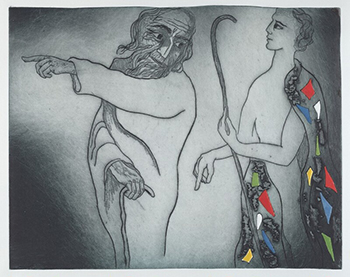
Peter Lipman-Wulf, Joseph and His Brothers IV (1966).
|
The first story that she wants to reclaim is the story of Joseph that we find introduced in this week’s lectionary readings. Joseph: the beloved son of Rachel and Jacob, the teenaged dreamer, betrayed by his own brothers, sold into slavery, and then slowly making his way into a position of power in Egypt that allows him to save his family from starvation. The story is rich and layered. Arrogance, jealousy, desperation, deceit, and grief all play a role. Joseph, while the story’s hero, is boastful and deceptive. He often seems not to know his own mind. And while he does eventually play a salvific role, it’s only after he seeks revenge.
Phelps-Roper loves this story for its complexity, but she also loves it because it speaks directly into her own family estrangement. She sees this story as not only about great events: the brothers’ decision to throw Joseph in a pit, Pharaoh’s dreams, the famine that draws Joseph’s family into Egypt where he lives unbeknownst to them. But it’s also the story of long empty periods of waiting: Joseph’s imprisonment, the many years when his father believes he is dead. She sees the story as allowing her to reflect on the question: How does she want to live in the meantime, while she still has little hope of reconciliation with her family?
And what does she want to do with her biblical inheritance? The Bible was used to hate and to hurt, to exclude and divide. But that’s not the whole story. She also sees the Bible as an inheritance of love, a record of connection. There’s joy in it as well as pain.
In a story thousands of years old, the same is true for Joseph’s inheritance. He has attempted to start over, and he has created a new identity. His long years in Egypt have made him into a different person than the child who was sold into slavery. He has become so Egyptian in his speech and his manners that his brothers never suspect his older identity, and he chooses to speak to them through an interpreter. He has a lot of ambivalence about reclaiming his identity as a son of Jacob — and for good reason.
 |
|
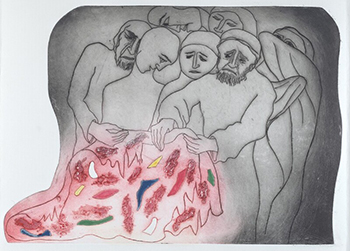
Peter Lipman-Wulf, Joseph and His Brothers VII (1966).
|
While he appears to have achieved some success and freedom, he carries that betrayal and the darkness of the pit inside of him, as a deeply buried reality — a story that he has never told over all of these years. His brothers too have been engaged in a long silence, keeping the true story of Joseph from Jacob, from Benjamin, and from their brother Rueben. Maybe they’d even come to believe their own account: that Joseph died in the wilderness, his bloody cloak as evidence.
In reflecting on this story, Thomas Mann wrote that Joseph’s desire to “set a beginning to the chain of events to which he belonged” encountered the same difficulty that such a desire always encounters: “Nothing comes first and of itself.” Every person has parents and therefore “points backwards, deeper down into the depths of beginnings, the bottoms and abysses of the well of the past.”
As a result, we all have legacies and those legacies are always mixed. Even what we’ve recovered from, turned away from, rejected is still with us. When we engage the Bible as scripture, we allow it to have just that kind of complicated legacy. No more and no less. As we interrogate it, we cannot help but interrogate ourselves, our pasts, our wounds, our exile as well as our hopes and our becomings. We don’t only point backwards. Like Joseph, we also point forwards: toward reconciliation, toward truth, and toward a reckoning with the past.
Weekly Prayer
Jan Richardson
Blessing That Becomes Empty As It Goes
This blessing
keeps nothing
for itself.
You can find it
by following the path
of what it has let go,
of what it has learned
it can live without.
Say this blessing out loud
a few times
and you will hear
the hollow places
within it,
how it echoes
in a way
that gives your voice
back to you
as if you had never
heard it before.
Yet this blessing
would not be mistaken
for any other,
as if,
in its emptying,
it had lost
what makes it
most itself.
It simply desires
to have room enough
to welcome
what comes.
Today,
it’s you.
So come and sit
in this place
made holy
by its hollows.
You think you have
too much to do,
too little time,
too great a weight
of responsibility
that none but you
can carry.
I tell you,
lay it down.
Just for a moment,
if that’s what you
can manage at first.
Five minutes.
Lift up your voice—
in laughter,
in weeping,
it does not matter—
and let it ring against
these spacious walls.
Do this
until you can hear
the spaces within
your own breathing.
Do this
until you can feel
the hollow in your heart
where something
is letting go,
where something
is making way.Jan Richardson is an artist, writer, and ordained minister in the United Methodist Church. She serves as director of The Wellspring Studio, LLC. Known for her distinctive intertwining of word and image, Richardson’s work has attracted an international audience drawn to the welcoming and imaginative spaces that she creates in her books, online blogs, and public events.
Amy Frykholm: amy@journeywithjesus.net
Image credits: (1) National Gallery of Art; (2) National Gallery of Art; and (3) National Gallery of Art.