From Our Archives
For earlier essays on this week's RCL texts, see Dan Clendenin, The Secret Life of Christians (2023); Debie Thomas, Is It Good for Us to Be Here? (2020); Dan Clendenin, The Majestic Glory (2017); Amy Frykholm, Illuminating the Ordinary (2011); and Dan Clendenin, The Transfiguration of Jesus: ‘The Real Truth’ or a ‘Pernicious Superstition’ (2008).
This Week's Essay
By Amy Frykholm, who writes the lectionary essay every week for JWJ.
2 Peter 1:19: “You will do well to be attentive to this as to a lamp shining in a dark place, until the day dawns and the morning star rises in your hearts.”
For Sunday February 15, 2026
Lectionary Readings (Revised Common Lectionary, Year A)
Psalm 2 or 99
2 Peter 1:16–21
Matthew 17:1–9
Annie Dillard’s enigmatic and fragmented treatment of time’s fleeting nature, For the Time Being, includes seven brief essays on clouds. She is not so much interested in clouds themselves as in why humans take it upon themselves to record them. She went digging through many sources looking for records of clouds — who recorded what cloudscapes on what day and even at what hour.
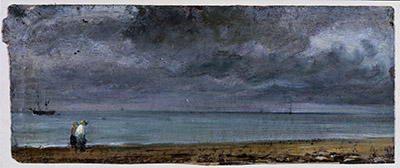
The first cloud record she includes in her book is from 1824. An English landscape painter named John Constable took his wife Maria to the coastal city of Brighton, hoping the sea air would cure her tuberculosis. On June 12, he painted gray clouds over the water in the receding twilight. The effect is portentous: something is coming. The clouds spill over the very edge of the painting, and two human figures stand on the beach huddled together against the ominous storm.
It seems strange, Dillard muses, that we still have these “dated clouds.” Maria died in November 1828, and John died in 1837, and yet we can, in a way, spend this one day with them on a beach more than a hundred years ago, through the clouds. We can feel the effect of them and stare with John into the future that he feared.
After ruminating on the paintings of 19th century landscape artists, Dillard turns to the journals of John Muir and Gerald Manley Hopkins — both recorders of cloudscapes. Muir mused, “What can poor mortals say about clouds?” They are even more ephemeral than us. Yet Muir uses their ephemerality to say something about God. “These fleeting sky mountains are as substantial and significant as the more lasting upheavals of granite beneath them. Both alike are built up and die, and in God’s calendar, duration is nothing.”
 |
|
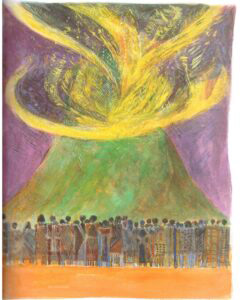
Avner Moriah, The Gathering at Mt. Sinai.
|
About Hopkins — the English Victorian poet and Jesuit priest — the scholar Connor Page writes that “his most basic stimulus for writing was meteorological.” He contributed observations to the journal Nature, and most of his journaling during the first year of his novitiate was about clouds. Clouds seem to be the best medium he had for exploring both his faith and his doubt, his wonder and his horror at both the presence and the hiddenness of God.
In these vignettes, Dillard doesn’t attempt to explain why people are drawn to documenting cloudscapes. She’s writing before a time when we can all, at any moment, pull a camera out of our pockets and record clouds. But she equates the action of recording a cloudscape as the equivalent of many of our attempts to hoard time. Why, she asks, save a letter, take a snapshot, write a memoir, or carve a tombstone? These are all gestures that attempt to cut across the inevitable erosion of time and save something for the future.
In this week’s lectionary texts, we confront a record of clouds that aren’t just ephemera. Arguably these are records of clouds that changed the course of human history. When Moses went up the mountain to receive the stone tablets from God, a cloud covered Mt. Sinai. To the Israelites down below, the text says, it looked like a “devouring fire” (Exodus 24:17), like their leaders had been completely swallowed up.
In this Exodus passage, God’s communication with Moses takes place inside the terrifying cloud, but in Psalm 99, a “pillar of cloud” is the means that God uses to communicate with the people. From a cloud, the psalmist says, Moses and Aaron and Samuel heard the voice of God and received the decrees and statutes that God gave them.
Matthew 17 vacillates between a bright vision and the obscurity of a cloud, as if the Transfiguration took place on a windy day when clouds raced in front of the sun, with dark and light alternating. First they saw Jesus “transfigured,” his face shining, with Moses and Elijah standing alongside. Just as suddenly a “bright cloud overshadowed them,” from which a voice spoke, “This is my Son, the Beloved; with him I am well pleased; listen to him!” (17:5). Then with no time to react, they looked up and saw Jesus in his ordinary aspect, “alone” (17:8). And when they tried to hold on to the memory of what they’d seen and perceive its significance, they were instructed “tell no one” (17:9). Is God playing hide and seek?
 |
|
John Constable, Brighton Beach (1824).
|
Some of the most enduring messages of our tradition come wrapped in clouds. I think of one of the stories about Rabbi Pinhas of Koretz. One of his students complained to him about the hiddenness of God. He answers, “It ceases to be hiding, if you know it is hiding.”
Is this a satisfying answer? At the very least we can note the paradox: from one the most ephemeral of natural phenomena come some of the most enduring messages of our tradition. Ancient peoples knew as well as we do that the world is an uncertain and dangerous place. The ground under our feet can shift without warning. The mountain that looks so solitary and unified and unchanging can suddenly start to smoke and pour lava. Clouds can start by looking innocent and end in terrifying catastrophe. In the midst of this kind of uncertainty, this week’s texts depict enduring revelations covered in clouds. Hiddenness, Rabbi Pinhas says, is not absence.
The stone tablets — given to Moses on Mt. Sinai and broken by him not long after in his fury over the golden calf — contain the Ten Commandments, the central text of the Jewish faith. The pillar of cloud taught Moses, Aaron, and Samuel the laws of God, which the psalmist tells us endure forever. Perhaps more ephemeral than either of these, and yet somehow carried forward by eyewitnesses (2 Peter 1:16), are these words about Jesus: “my Beloved.” We are still wondering about this cloud thousands of years later.
Henri Nouwen suggests that Jesus gives this experience to Peter, James, and John so that they could “cling to it” during the rough days ahead, as perhaps the Ten Commandments were given to the people as a roadmap as they passed through the wilderness. Would this transitory and disputed story really have been a comfort? We all know, despite Peter’s declaration in 2 Peter, that eyewitness testimony isn’t as reliable as we’d all like.
 |
|
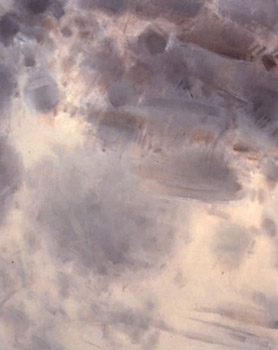
Jacqueline Gourevitch, Sky #125 (1989).
|
What if each of them came away with a different memory of it, as is typical in human experience? James said the voice came first and then they saw Jesus with Moses and Elijah. John only saw Moses. Peter was so terrified, he didn’t remember what he saw, but he does remember that he was proposing a construction project when he was interrupted by a voice coming from a cloud. Anything they did to make sense of all of this was interrupted by Jesus telling them not to tell anybody.
This makes me think that perhaps the experience wasn’t given to the disciples so that they could cling to it. Perhaps it was given to them so that they could practice letting go. On the difficult path ahead, they are going to have to let go of Jesus again and again. Here they are asked to let go of even a vision so profound that it was called “transfiguration.”
Maybe living with the coming and going of clouds incapsulates this lesson daily. “And thus I saw him and I sought him,” Julian of Norwich writes. “And I had him and I lacked him.” This isn’t something to mourn, she counsels, but is instead “the common working of this life.” We glimpse God, and then God goes behind a cloud. In this way, we learn to love rather than cling.
Weekly Prayer
Malcolm Guite (b.1957)
For that one moment, ‘in and out of time’,
On that one mountain where all moments meet,
The daily veil that covers the sublime
In darkling glass fell dazzled at his feet.
There were no angels full of eyes and wings
Just living glory full of truth and grace.
The Love that dances at the heart of things
Shone out upon us from a human face
And to that light the light in us leaped up,
We felt it quicken somewhere deep within,
A sudden blaze of long-extinguished hope
Trembled and tingled through the tender skin.
Nor can this blackened sky, this darkened scar
Eclipse that glimpse of how things really are.Malcolm Guite (b.1957) is an English poet and Anglican priest. This comes from Sounding the Seasons (Canterbury Press, 2012).
Amy Frykholm: amy@journeywithjesus.net
Image credits: (1) The Schechter Institutes, Inc.; (2) Victoria and Albert Museum, London; and (3) Artwork Archive.