
From Our Archives
For earlier essays on this week's RCL texts, see Dan Clendenin, The Deepest Font of the Human Heart (2023) and Debie Thomas, Words Are Not Enough (2020).
This Week's Essay
By Amy Frykholm, who writes the lectionary essay every week for JWJ.
Philippians 2:13: “God is at work in you.”
For Sunday September 27, 2026
Lectionary Readings (Revised Common Lectionary, Year A)
Psalm 78:1–4, 12–16 or Psalm 25:1–9
Philippians 2:1–13
Matthew 21:23–32
In Clothed in Language, poet, scholar, and Benedictine oblate Pauline Matarasso defines God’s will as “the next thing I least want to do.” Sigh. I would like to disagree with this. I would like to write that in fact, God’s will is to give us the desires of our hearts. Which may also be true. But first, perhaps, we have to confront the reality that the will of God is often contrary to what we know our immediate desires to be.
Right now I do not want to be writing this essay. Assuming that writing this essay is God’s will, I would rather not. My backside hurts from a fall I took yesterday while doing my new favorite thing: roller skiing. And as a result, my back, my neck, and my head are all participating in a pity party. I would like to go back to bed.
But also, time is short. I have a translation manuscript that is due soon, and I woke up panicking about a sentence that I had inadvertently put in the wrong verb tense. How many more wrong verb tenses are there? Is there a wrong verb tense on every page? How will I know unless I go through every page (yet again) and check?
Not to mention the fact that I just agreed to read End Times Fascism with a friend from elementary school. Bill and I have been in an intellectual battle since the second grade, and I am already dreading the high-powered, intense conversations we will need to have and have been having — maybe not since the second grade, but certainly since he and I were sitting in a cafe in our home town and he called me “pretentious.” And I went around for a week afterward asking anyone who I thought would answer if I was pretentious.
Reading End Times Fascism with Bill might also be “the next thing I least want to do.”
 |
|
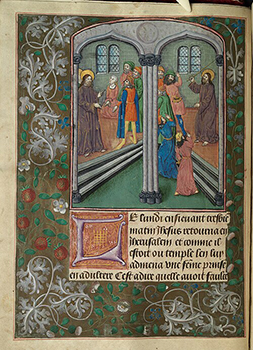
Anonymous, Two Scenes in the Temple (c.1508).
|
What else would fit in that category? Apparently getting up from the couch and getting dressed. Combing my hair. Biking to contemplative prayer in the threatening rain. I’m not saying that all of these things are precisely the will of God, but they are all involved in “the next thing I least want to do.”
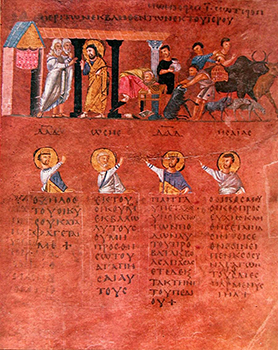
There is a baseline resistance to God’s will that Jesus calls out in Matthew 21. Jesus, on the road toward his death, has entered Jerusalem on a donkey. Then he overturns the tables in the temple and offends all the people who are regulars there. He uses the empty space to heal the lame and the blind. That is day one.
On day two he wakes up hungry and seems to be in a bad mood. He withers a fig tree for not having figs (we all are supposed to know who the figurative fig tree is, but this literal one pays a big price). Then he goes back to the temple to meet the many people he made such good friends with the day before. This is where we meet him.
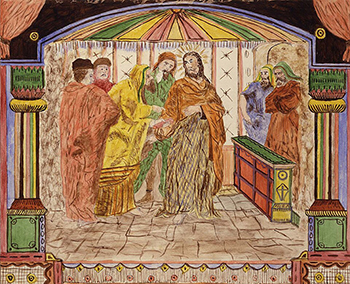
Because of the tumult Jesus caused, we can understand the questions of the religious leaders in the temple. “By what authority do you do these things and who gave you this authority?” (Matthew 21:23). There is a sneer in these questions: Who do you think you are, day laborer, nobody, know-it-all, rabbi of the rabble?
Jesus answers their question with another question. “Did the baptism of John come from heaven or was it of human origin?” (Matthew 21:24). I wonder if the trick in this question is that the incarnation makes the answer: both. John’s baptism portended heaven coming to earth, taking earthly form.
But the religious leaders think it is an either/or question, and they see the downsides of answering either way. They are thinking as rhetoricians: what answer will give us what we most want? Since they can’t decide, they say “we don’t know.”
 |
|
Rossano Gospels, The Cleansing of the Temple (6th c.).
|
This “we don’t know” is not humble; it’s strategic. It’s a salvo in a rhetorical battle. But Jesus is not as concerned with winning the rhetorical battle as he is exposing the darkness to the light, bringing forward the religious leaders’ inward thoughts.
And so he launches a series of parables that make the religious leaders so angry that by the end of the chapter, they are ready to arrest him.
The first parable is about two sons. A man goes to the first son and says, “Son, go and work in the vineyard today.” That son says, “I will not.” But then he changes his mind and goes anyway. Then the father goes to the second son and makes the same request. This son says, “I will,” but then doesn’t go. Jesus asks the religious leaders, “Which son did the will of the father?” They finally have a question they can answer. “The first one” (Matthew 21:28-31).
While this parable is about exposing the religious leaders and their hypocrisy, the first in a series of hostile parables directed at their failures, it is also about that peculiar resistance to the will of God in our lives. I read this parable as about the narrow road to doing the will of God in my own life.
I understand the first son’s resistance to the call on his life, his initial “no.” No, thanks, I fell yesterday and I am sore today. No thanks, I’m tired. I’ll go tomorrow. In The Pivot Year, Brianna West writes, “The resistance within is brilliant. It knows every terrifying thought you have ever had and every fear to play on. It knows what you will respond to, what will seduce you, what will scare you into staying frozen.” This resistance is eloquent, articulating our fears and our anxieties, as well as giving voice to that slothlike creature that dwells within, the Bartleby the Scrivener in many of us, saying, “I would prefer not to.”
 |
|
Lawrence W. Ladd, Christ and the Pharisees (1880).
|
But something changes for the first son. Somehow his no becomes yes. The moment intrigues me. How does he change his mind? The text leaves it a mystery, a lacuna that invites our imaginations.
I have a new friend who spent most of his adult life in prison. I’ve only met him on the other side of this deep wilderness. “My life now,” he says, “is about doing the next right thing.” This is related to Matarasso’s phrase about the “next thing I least want to do.” My new friend cannot count on the next right thing being the thing he most wants to do. He has to rely on a deeper sense of showing up anyway. I’ve observed in him a profound humility in his willingness to examine the present moment for the next right thing. He’s following Carl Jung’s injunction to “seek daily the will of God.”
At the same time, I believe that the change in the first son is related to a deeper awakening. It is not only about overcoming an initial resistance. Underneath my resistance, my frozen fear, my laziness is a deeper desire: the desire to serve, the desire to be a part of the greater work of God. In a recent newsletter, Anne LaMott wrote, “This is just about my deepest belief, that we think we are starving for what we’re not getting, but we’re actually starving for what we’re not giving.”
The first son wakes up to this hunger, his deeper desire. That’s the one that causes him finally to say yes.
Weekly Prayer
Edwina Gately (b.1943)
We are called to say yes.
That the kingdom might break through
To renew and to transform
Our dark and groping world.We stutter and we stammer
To the lone God who calls
And pleads a New Jerusalem
In the bloodied Sinai Straights.We are called to say yes
That honeysuckle may twine
And twist its smelling leaves
Over the graves of nuclear arms.We are called to say yes
That children might play
On the soil of Vietnam where the tanks
Belched blood and death.We are called to say yes
That black may sing with white
And pledge peace and healing
For the hatred of the past.We are called to say yes
So that nations might gather
And dance one great movement
For the joy of humankind.We are called to say yes
So that rich and poor embrace
And become equal in their poverty
Through the silent tears that fall.We are called to say yes
That the whisper of our God
Might be heard through our sirens
And the screams of our bombs.We are called to say yes
To a God who still holds fast
To the vision of the Kingdom
For a trembling world of pain.We are called to say yes
To this God who reaches out
And asks us to share
His crazy dream of love.Edwina Gately (b.1943) is an English-American poet, who spent much of her life in Chicago, serving among HIV patients and women coming out of prostitution. She is currently writing, leading retreats for abused and marginalized women, and serving as "Mother Spirit" for Exodus, a program in Chicago for women in recovery from prostitution.
Amy Frykholm: amy@journeywithjesus.net
Image credits: (1) Wikimedia.org; (2) Wikipedia.org; and (3) Wikimedia.org.



.jpg)

.jpg)