From Our Archives
For earlier essays on this week's RCL texts, see Michael Fitzpatrick, No Right to Opinion (2023); Debie Thomas, Unpacking Forgiveness (2020); and Dan Clendenin, Never Judge, Always Forgive (2017).
This Week's Essay
By Amy Frykholm, who writes the lectionary essay every week for JWJ.
Psalm 114:7: “Tremble, O earth, at the presence of the Lord, at the presence of the God of Jacob.”
For Sunday September 13, 2026
Lectionary Readings (Revised Common Lectionary, Year A)
Psalm 114 or Exodus 15:1b–11,20–21 or Psalm 103:(1–7), 8–13
Romans 14:1–12
Matthew 18:21–35
It’s a little daunting to realize that what you give your attention to is what you give your life to. Attention is our capacity to care.
And attention is currently, among many resources, our most precarious. It is being threatened by a vast and meticulous economy that really does want our attention divided, fractured, and enslaved, the better to monetize our very humanity.
In this week’s lectionary, we explore the movement from enslavement to freedom. As Rabbi Ted Falcon writes in his Haggadah, “The Haggadah takes us on a spiritual journey. We learn to be freed from our inner pharaohs, travel in our wilderness, and form our own dreams of the Promised Land.”
When we apply this template to our current reality, we perhaps observe that many of us now have the same inner pharaoh. When I first heard Rabbi Ted speak this way many years ago, I imagined that the inner pharaoh was an individual problem. Rabbi Ted writes, “We carry Pharaoh within ourselves. We seek to remember that we hold the keys to our slavery and our freedom. We seek to recognize that the world reflects our own beliefs back to us. We keep ourselves stuck with limiting thoughts like: I can’t, I’m not good enough, I’m not ready yet, and I don’t deserve better. And we trap ourselves by holding on to fear and anger and an unwillingness to forgive. We confine ourselves by living in the past or future and never fully experiencing the present. And we imprison ourselves by acting according to what we think is in the mind of others.”
All of this is true, even profound. But the problem we face at our current moment is perhaps even more dire. We each have our own inner enslavers who steal our resources for different purposes: addiction, ambition, greed, and so on. But one core problem of our current moment is that our particular enslavements are becoming a common and collective enslavement. The inner pharaoh is also a collective pharaoh. And our inner slavery is now shared, and one that we can all only emerge from as a society.
For the last few weeks, I’ve been enrolled in a short class from the Strother School of Radical Attention, a school that seeks to reimagine what freedom might look like for our current reality. The Strother School has landed on the metaphor of human fracking for what is happening to us. Since human attention is the resource out of which we care for ourselves, our communities, and our planet, the fracturing and pollution of our attention means that “all forms of life suffer.” (I am quoting throughout this essay from the Strother School’s recently published manifesto Attensity.)
 |
|
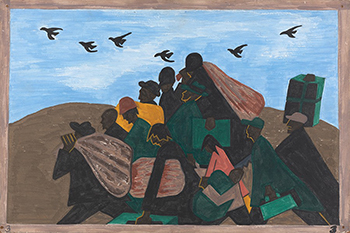
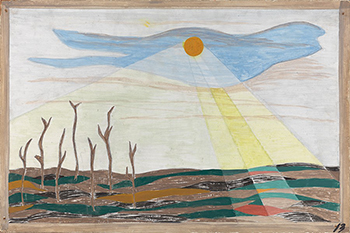
Jacob Lawrence, The Migration Series (1940-41).
|
The Strother School notes that our digital devices are designed to pump huge amounts of poisonous junk deep into our minds in order to draw out that precious raw material called attention, and then monetize it. Attention, they say, is “soul-water;” and the “attention merchants,” as Tim Wu calls them, want as much of this precious resource as they can get.
It sounds quite paranoid as I write it, and yet this situation is certainly as out of hand as it was for the Israelites in Egypt who were “groaning under the weight of oppression” (Exodus 2:23). Our own groaning is far subtler and more insidious than any pharaoh ever could cause. The forces that enslave us are chosen by us, and yet they are taking control of us in ways that we could never actually consent to, or have the opportunity to consent to. Consent itself is taken as part of the transaction.
But like the Israelites, we all have to enter the fracklands. They are part of our daily lives. We check our bank records; we send an email; we communicate with loved ones; we read the news. And we watch our loved ones and ourselves being drawn in to an ever more expanding symbolic Egypt, driven by algorithms that want, even demand, our life-energy. Even though we feel like we’ve become enslaved by choice, and we blame ourselves, this is not the case. Our enslavement was planned and programmed. It was done by “meticulous design,” as one of my classmates said.
 |
|
Jacob Lawrence, The Migration Series (1940-41).
|
Shoshana Zuboff states the case pretty clearly in an essay called “Surveillance Capitalism and the Challenge of Collective Action” (also the name of her book). She notes that the future wealth of the human frackers depends on their ability to get into “your bloodstream and your bed, your breakfast conversation, your commute, your run, your refrigerator, your parking space, your living room, your pancreas.” The surplus data they are looking for has to be “plumbed from the intimate patterns of the self.” Emergent technologies — like gait and facial recognition, posture analysis, and text analysis — “lay bare your personality, moods, emotions, lies, and vulnerabilities.”
“Now it violates the inner sanctum,” Zuboff writes, “as machines and their algorithms decide the meaning of your sighs, blinks, and utterances; the pattern of your breathing and the movements of your eyes.”
In the Haggadah, Rabbi Ted writes, “As we name each of the plagues, we take a drop of wine from our cups to acknowledge that the destruction of any person, even an enemy, diminishes our own joy.” As we watch the people around us consumed by these practices, and even ourselves feel fracked, we come to the same recognition. The diminishment of any person’s joy is the diminishment of all of us. Rabbi Ted writes that according to the Zohar, the central text of the Jewish mystical tradition, “our energies contribute to the universal field. Just as we are influenced by energies far greater than ourselves, so, too, our own consciousness affects the Whole.”
We must start reimagining a new freedom, and this task is as profoundly difficult as the one that the Israelites faced in this foundational story. The Strother School writes that “just like we all have to breathe the air that the polluters pump out, we need an environmental movement that is about our inner environments — our minds, capacities, relationships.”
 |
|
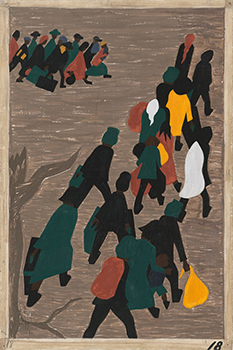
Jacob Lawrence, The Migration Series (1940-41).
|
Rabbi Ted draws attention to a moment in the Midrash — an ancient text that expands on the biblical story — in which the Israelites are standing on the edge of the sea. They can see ahead of them the path to freedom, and it is covered by water. The people are terrified, caught between the pursuing Egyptians, on the one side, and the powerful, impassible force of the sea in front of them. Then a person remembered as Nadday ben Aminaday pushes to the front of the crowd and begins to walk into the water. Only when the water is up past his neck does the sea part, allowing the people to cross over. “Like our ancestors enslaved in Egypt, we cannot commence our Exodus, our journey to freedom, unless we perform some conscious act. Such an act necessarily entails leaving behind that which is comfortable and secure. And such an act, therefore, involves some risk.”
The Strother School suggests that the risk most needed right now is the risk of community: creating sanctuaries together where the frackers cannot go. Chances are good we already are participating in them and creating them; we might not recognize the larger necessity of which they are a part. We need places for dreaming, places for singing, dancing, reading, studying together, being human together, celebrating, mourning, connecting.
“There is but one Light,” Rabbi Ted writes, “and it awakens within each of us. This is the Light that guides us through the wilderness that comes between every Egypt and every Promised Land.”
Weekly Prayer
Psalm 103
Bless the Beloved, O my soul,
and all that is within me;
I bless your Holy Name!
Bless the Beloved, O my soul,
and remember the goodness
of Love.
You forgive our stubbornness
You heal our disease,
You save us from the snares
of fear,
You crown us with steadfast
Love and Mercy,
You satisfy our every need and
renew our spirit like
the eagle’s.Through you comes peace and
justice for all who are
oppressed.
You make known the pathway of
truth,
and guide us on the Way.You are merciful and gracious,
quelling our anger with your
patient Love.
You love us more than we can ask
or imagine;
in truth, we belong to You.
For You understand us,
requiting us not according to our
ignorance and error.
As far as the heaves are high above
the earth,
so great is your loving response
toward those who are humble;
So far does your enduring strength
uphold those who face the
darkness within.
As parents are concerned for their
children,
so You come to those
who reach out in faith.
For our ways are known, our weaknesses
seen with compassion.As for humanity, our days are like
the grass;
we flourish like a flower of
the field;
When the wind passes over,
it is gone,
and that place knows it no more.
Yet the steadfast Love of the Beloved
is from everlasting to everlasting
to those who Awaken
and justice to all generations,
To those who remember your Promises
and follow your Voice.The Beloved’s home is in our hearts,
as we discover in Silence.
Bless the Beloved, O you angels,
you faith-filled ones who hear
the Word,
following the Voice of Love!
Bless the Beloved, all you people,
those who abandon themselves
into Love’s hands!
Praise the Beloved, praise all of Creation!
Praise the Beloved, O my soul!Paraphrase by Nan C. Merrill in Psalms for Praying: An Invitation to Wholeness (Bloomsbury, 2006) p.201-203.
Amy Frykholm: amy@journeywithjesus.net
Image credits: (1) The Phillips Collection; (2) The Phillips Collection; and (3) The Phillips Collection.