From Our Archives
For earlier essays on this week's RCL texts, see Dan Clendenin, Exodus and Exile (2023); Debie Thomas, Losing and Saving (2020); and Dan Clendenin, Moses and the Burning Bush (2017).
This Week's Essay
By Amy Frykholm, who writes the lectionary essay every week for JWJ.
Exodus 3:3: "Then Moses said, 'I must turn aside and look at this great sight and see why this bush is not burned up.'"
For Sunday August 30, 2026
Lectionary Readings (Revised Common Lectionary, Year A)
Psalm 105:1–6, 23–26, 45c or Psalm 26:1–8
Romans 12:9–21
Matthew 16:21–28
In the early part of the year 384 (CE), a woman named Egeria traveled to Mount Sinai. She had been on the road for several years, traveling from her home in Spain to the city of Jerusalem because she wanted to document something called the “Jerusalem liturgy” and bring aspects of it home to her “sisters,” a community of women about whom we know nothing. Her letter home — a detailed document of her travels — was lost for several centuries. A partial manuscript was found in Italy in the 19th century.
She had been living in Jerusalem for three years when she decided to travel to Egypt to see Mount Sinai. Her passion was biblical sites, and wherever she went, if a biblical site was mentioned, she asked to have a reading of that passage done at the site while she was looking at it. “Biblical sites” are in fact the first two words of the partial manuscript that we have of her travels.
John Wilkinson, who translated Egeria for the version of her Travels that I have, says that Egeria’s Latin is “unusual.” Others have called it “a mess” and still others “epic.” She probably wrote as she spoke and spoke a version of Latin to her sisters that had also passed through numerous cultures and dialects. Her method seems to have been to scribble notes and then later create a more sustained narrative when she had time — and, I imagine, had recovered somewhat from her long treks.
So Egeria left Jerusalem and traveled “twenty-two posts” to Mount Sinai. At this time, in the absence of Jews living in these lands, Christians were in the process of appropriating Jewish sites and interpreting Hebrew texts through their own experience, even as they relied on Jewish tradition to tell them where certain sites were. They also not infrequently misunderstood the tradition from which they were borrowing — mistaking various names and places in pursuit of their exercise in biblical mapping.
 |
|
Moses and the Burning Bush, wall painting, Dura Europoa synagogue, c. 245 AD.
|
But it wasn’t just mapping that these early Christian pilgrims were doing. It was enacting a particular relationship between text and landscape through veneration. Everywhere she went, Egeria paused to venerate the places, to undergo whatever rituals were traditional to that place, and to have the biblical passages read to her. She was trying to connect three disparate things: her own imagination, the text, and the foreign landscapes through which she traveled. She did this by making offerings, saying prayers, and through reading familiar texts. And then she tried to pass this experience on to her sisters, even though they couldn’t see the landscape. She wanted to give them this missing piece, to have them see as she saw.
When I first read Egeria’s Travels several years ago, I was struck immediately by her visit to the burning bush.
“This, as I have already said, is the Burning Bush out of which the Lord spoke to Moses, and it is at the head of the valley with the church and all the cells. The Bush itself is in front of the church in a very pretty garden which has plenty of excellent water. Near by you are also shown the place where holy Moses was standing when God said to him, ‘Undo the fastening of thy shoes,’ and so on.”
My experience was one of incredulity. How could you visit the burning bush? I pictured Moses, out wandering with his father-in-law’s flocks near Mount Horeb. The text doesn’t offer an exact location, though Egeria seems to know it. Then I imagined the minimum of a thousand years that passed between this event and its recording — and archeologists are divided on the historical accuracy of any of it. I thought about how these texts passed from generation to generation from that time to Egeria’s time, through various languages and cultures, wars, exiles, earthquakes, fires, floods — the whole shaky enterprise that is human history. I thought about how the very meaning of the relation between text and landscape would have changed through all of those passages.
But she writes, “The Bush is still there!” And notes that it is tended by a community of Christian monks. (And this is true to this day. The Chapel of the Holy Bush is the most ancient site venerated by the monks of the Mount Sinai Monastery.)
 |
|
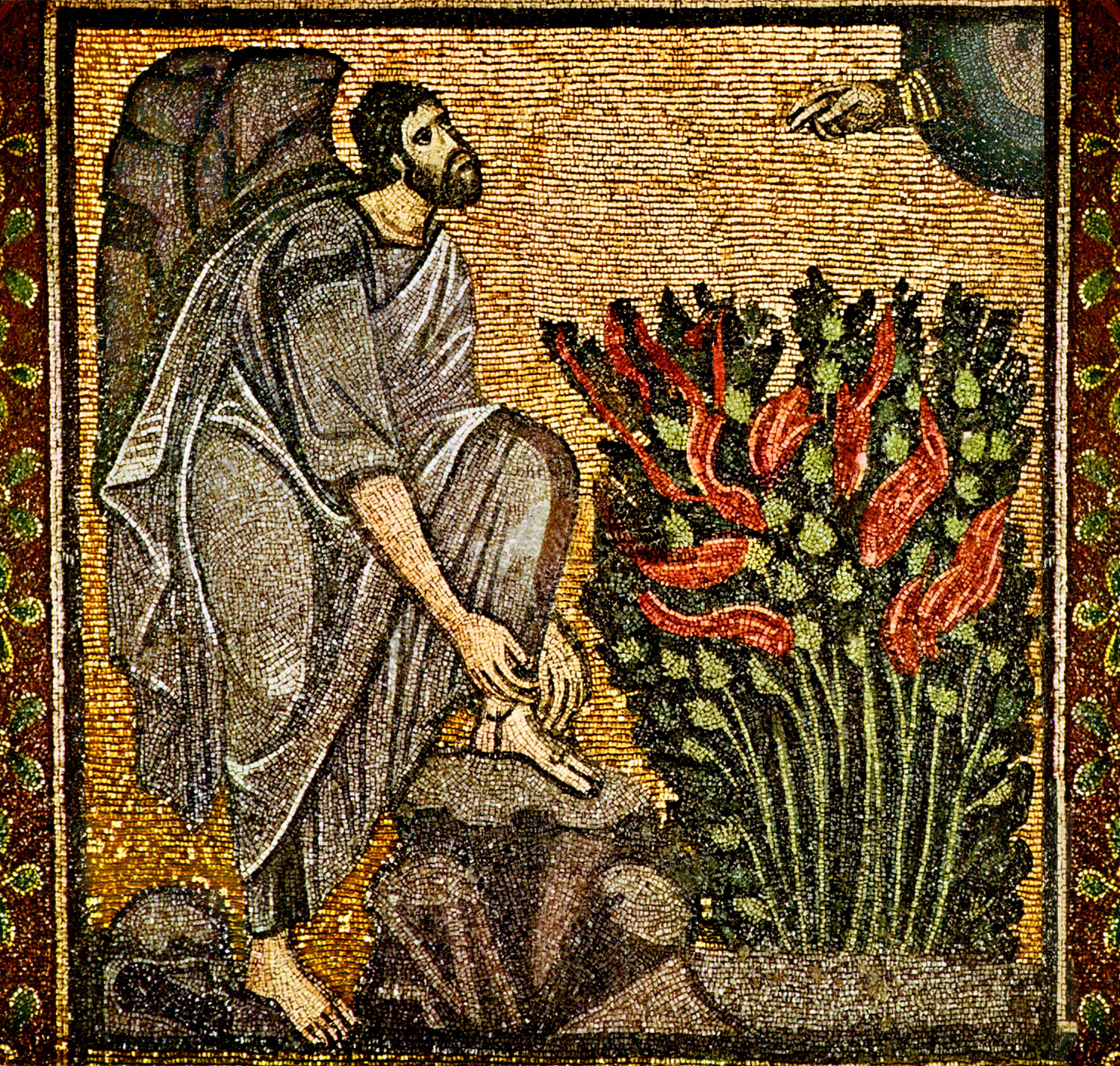
Moses and the Burning Bush, Byzantine mosaic, c. 9th century.
|
I had thoroughly come to understand the burning bush as a symbol: a symbol of God’s presence, a symbol of God’s urgent call, a symbol of God’s interaction with human history and his desire for the people’s freedom. But I had never thought of it as an actual bush. And Egeria had. The strangeness of this made me want to dismiss her, on the one hand. How completely ridiculous! To think that you could see the burning bush! But her impassioned curiosity about the land and its people, her attention to the details of that land — its plants, its topography, and its relationship to the text that she held as sacred — made me want to learn from her.
In her boundless curiosity, she writes to her sisters, as if apologizing for all the details in a travel blog, “I know it has been rather a long business writing down all of these places one after the other, and it makes far too much to remember. But it may help you, loving sisters, the better to picture what happened in these places when you read the Books of holy Moses.”
I wonder if it might have helped because Egeria’s descriptions might have stimulated the sisters’ curiosity, and if their curiosity and imaginations were enlivened then they might have been able to understand a little better who Moses was and how God interacts with human beings and they might then have been able to bring this into their own lives.
Egeria’s curiosity is mirrored by Moses’ curiosity in Exodus 3. Moses is going about his ordinary business of tending flocks, albeit in extraordinary circumstances. He has fled Pharaoh after killing an Egyptian and is biding his time in the desert. On this particular day, he may have wandered a little farther than usual because the text says that he had taken the flock out “beyond the wilderness” (Exodus 3:1).
 |
|
Moses and the Burning Bush, Michiel van der Borch, Koninklijke Bibliotheek, The Hague, 1332.
|
He sees a bush that is “blazing, yet not consumed” (Exodus 3:2), but he doesn’t immediately understand what he was seeing. He becomes curious. “I must turn aside and look at this great sight and see why the bush is not burned up.” God notices that Moses has “turned aside” and then calls to him. Imagine if Moses had ignored that little impulse, that desire to know more.
I suppose that a burning bush that is not consumed is a big thing to notice, but the passage suggests that Moses could have walked by it. It wasn’t directly in his path. It wasn’t endangering him or his flock. He could have stayed focused on his primary duty and not turned to look. Moses’ life was dramatically changed by his choice to “turn aside” in curiosity.
The poet William Stafford called this kind of curiosity and the following that it leads to “the golden string.” And unlike Egeria or Moses, he saw the “end of a golden string” in everything, in every detail of human life that we notice enough to write down. For Stafford, the whole of the sensual world was alive with the possibility of the sacred practice of noticing. Which makes me wonder: what did I walk by today that I could have turned aside to see with curiosity? What ends of the golden string did I pass by?
Weekly Prayer
Gerald Manley Hopkins (1844–1889)
As kingfishers catch fire, dragonflies draw flame;
As tumbled over rim in roundy wells
Stones ring; like each tucked string tells, each hung bell's
Bow swung finds tongue to fling out broad its name;
Each mortal thing does one thing and the same:
Deals out that being indoors each one dwells;
Selves — goes itself; myself it speaks and spells,
Crying Whát I dó is me: for that I came.
I say móre: the just man justices;
Keeps grace: thát keeps all his goings graces;
Acts in God's eye what in God's eye he is —
Chríst — for Christ plays in ten thousand places,
Lovely in limbs, and lovely in eyes not his
To the Father through the features of men's faces.Gerald Manley Hopkins (1844–1889) was an English-Catholic poet who was ordained to the Jesuit order in 1877. Upon becoming a Jesuit, he burned much of his early verse and abandoned the writing of poetry. But he started writing poetry again in 1875 and he produced his best poetry after that. His verse is noted for its piercing intensity of language and its experiments in prosody. This poem is from Poems and Prose (Penguin Classics, 1985).
Amy Frykholm: amy@journeywithjesus.net
Image credits: (1) Textweek.com; (2) Iconreader.wordpress.com; and (3) Blogspot.com.