From Our Archives
For earlier essays on this week's RCL texts, see Dan Clendenin, Church and State on the 4th of July (2023); Debie Thomas, A Lighter Burden (2020); and Dan Clendenin, Failure-Tolerant Christians (2011).
This Week's Essay
By Amy Frykholm, who writes the lectionary essay every week for JWJ.
Psalm 145:8: “You are gracious and compassionate, long-suffering and overflowing with kindness.”
For Sunday July 5, 2026
Lectionary Readings (Revised Common Lectionary, Year A)
Psalm 145:8–14
Romans 7:15–25a
Matthew 11:16–19, 25–30
In a recent essay in The New York Times, Meghan O’Gieblyn writes about the time when her eleven years-long sobriety failed. She was in Rome, contracted COVID, and in the isolation and freedom she started drinking again. She woke up many mornings “in a panic of alcohol withdrawal, limbs covered in sweat, and spent the afternoons wandering aimlessly through the city center, dwarfed by the battlements of ancient fortresses, seeking shade beneath the statues of war heroes.” There was no reason for this: no life-crisis, no good explanation. Something inside her — an unnameable and seemingly unknowable force — had turned against the good life she had created and plunged her into self-destruction.
Why, she asks in the essay, do we poison ourselves? Very few accounts of human motivation can make sense of why we do what we do — or why as St. Paul so classically posits in this week’s lectionary, “I do not do what I want, but I do the very thing I hate” (Romans 7:15). In her essay, O’Gieblyn cycles quickly through the Western tradition’s attempts to grapple with this bare fact of our human existence: Augustine’s descriptions of a weak human will, Arthur Schopenhauer’s observation that the will acts as a “transpersonal force of creative destruction” working against rational self-interest, and Sigmund Freud’s “death drive.”
In the end, O’Gieblyn writes, she has never seen a truly compelling account answering why we are self-destructive. But of all the solutions proposed to counter the problem, she has found what she calls “the Christian solution” the most compelling: give in, surrender to a power greater than yourself. “It was a moment of utter failure and desperation that would later lead me to confess my relapse to my husband and return to the recovery community that has been foundational to my sobriety these past four years.”
 |
|
Georgia O’Keeffe, Black Cross with Stars and Blue (1929).
|
While the impulses that led O’Gieblyn into her relapse are ancient, we now at least have a word for these self-destructive impulses within ourselves, for the reality that “while the desire to do the good lies close at hand, the ability does not” (Romans 7:18). We call it “addiction.” Lived experience tells us that addiction is not the fate of the unhappy few. It is an inner reality, an inner enslavement, that we all are subject to.
Several years ago when I was teaching at a local community college, I had a student who was failing my class. I was a young and inexperienced teacher, and I was definitely taking his failure personally. I gave him an extension. I offered to meet with him one-on-one and help him finish the class. I desperately wanted him to succeed. Finally, one day, we met in the hall. “Professor,” he said with compassion, “just fail me. I’m not going to finish. Just give me an F, and we can both move on.”
Later, in a church-related context, the student and I got to know each other better. I learned that he had struggled with alcohol since he was twelve years old and had alcoholic parents. I came to see the beautiful human being whose addiction was preventing him from moving forward. I also saw that there were no easy answers, and a passing grade in my class was certainly not one of them.
On the one hand, I offered to support him in rehab if he was willing to go. On the other hand, he and I both knew that rehab wasn’t a magic bullet solution to the difficulties he was facing. Maybe it would help. Maybe it would be better than nothing. But I also had the sense that the best thing I could do was simply to move into a position alongside him, for us to become fellow sufferers of the trap in which he had so painfully found himself. The good did indeed lie close at hand, but the ability to enact it seemed far away. Saying as much helped.
 |
|
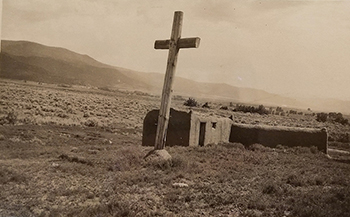
Unknown photographer, Penitente Cross and Morada behind Mabel Dodge Luhan’s Property (ca. 1924–1950).
|
One of the things I appreciate about Romans 7 is that Paul is grappling with something he doesn’t have answers for. He doesn’t even have a complete vocabulary for it. He writes, “I see in my members another law at war with the law of my mind, making me captive to the law of sin that dwells within my members” (Romans 7:23). “A law within my members” is certainly an awkward formulation to talk about inner conflict. He struggles to locate these impulses. Experience suggests to me that even becoming skilled at talking about our inner conflicts doesn’t resolve them.
The word “law” suggests something that has been put in place against our will, but is deeply rooted. The word “members” suggests that this is a problem constitutive of being human — it’s built into the dynamic and complex make-up of the person — a make-up that involves plural impulses, plural desires, competing ideas of self-interest.
Paul doesn’t use the past tense here. He doesn’t say, “All of this used to be the case, but now I’m free!” This is not an “I was lost and now I’m found” moment. Not at all. The “war within the members” is an ongoing reality. Freedom and slavery dwell simultaneously within us. The opportunity to choose is ever present.
 |
|
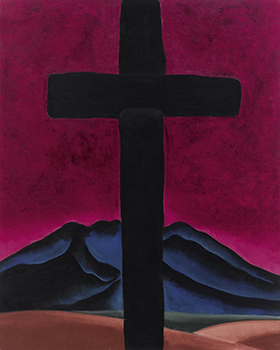
Georgia O’Keeffe, Cross with Red Sky (1929).
|
But perhaps most importantly, the paradox of Paul’s position is not to become stronger in our resistance, but to become more present to our weakness. “My grace is sufficient for you,” God says to Paul. “My power is made perfect in weakness.” Therefore, Paul writes, “I will all the more gladly boast of my infirmities” (2 Corinthians 12:9).
There ought to be no robust account of sin without a robust account of grace. In her walks around Rome in self-created misery, O’Gieblyn writes that moments of grace were available to her everywhere. “The mother who baptized her child’s sweaty head with handfuls of cold water from the public fountain. The couple who covered the bill of a tourist who didn’t realize the cafe accepted only cash. The stranger who gave me the rest of his water bottle when I nearly fainted on the marble steps of the Pincian Hill.”
This is not the stingy grace doled out by my own inner tyrant, who in response to my failings and stumblings metes it out as if there were a limited quantity. The grace that O’Gieblyn refers to is an unending, unquantifiable outpouring of love that we never live without. The good news that Paul points to at the end of this passage isn’t a proposal for fixing what’s broken so much as a declaration that we are loved regardless. In being able to perceive this love, we are relieved of the burden of our inner war. Through love, those who are “weary and heavy-laden” find rest (Matthew 11:29).
Weekly Prayer
George Herbert (1593–1633)
BROKEN in pieces all asunder,
Lord, hunt me not,
A thing forgot,Once a poor creature, now a wonder,
A wonder tortur’d in the space
Betwixt this world and that of grace.My thoughts are all a case of knives,
Wounding my heart
With scatter’d smart,As wat’ring pots give flowers their lives.
Nothing their fury can control,
While they do wound and prick my soul.All my attendants are at strife,
Quitting their place
Unto my face:Nothing performs the task of life:
The elements are let loose to fight,
And while I live, try out their right.Oh help, my God! let not their plot
Kill them and me,
And also thee,Who art my life: dissolve the knot,
As the sun scatters by his light
All the rebellions of the night.Then shall those powers, which work for grief,
Enter thy pay,
And day by dayLabour thy praise, and my relief;
With care and courage building me,
Till I reach heav’n, and much more, thee.George Herbert (1593–1633) was an English poet and clergy person. He graduated from Cambridge and, after his mother died, entered the parish as a priest. In 1629 Herbert became the rector at Bemerton, a small village near Salisbury, where he spent the rest of his short life. In Bemerton he preached, wrote poetry, served the pastoral needs of his people with loving distinction, cared for the poor, and even helped to rebuild the church using his own resources. He died of tuberculosis one month before his fortieth birthday. None of his poems had by then been published. Today he is revered as one of the most significant poets of his era.
Amy Frykholm: amy@journeywithjesus.net
Image credits: (1–3) Center for the Study of Material and Visual Cultures of Religion.