From Our Archives
For earlier essays on this week's RCL texts, see Dan Clendenin, A Man Born Blind (2023); Debie Thomas, Now I See (2020); Sr. Nancy Usselmann, FSP, The Light of Grace (2017).
This Week's Essay
By Amy Frykholm, who writes the lectionary essay every week for JWJ.
Ephesians 5:8: “Walk as children of light.”
For Sunday March 15, 2026
Lectionary Readings (Revised Common Lectionary, Year A)
Psalm 23
Ephesians 5:8–14
John 9:1–41
Barbara McClintock began her pioneering career in genetics by, of all things, staring at corn. Decades later she won the Nobel Prize for Medicine, but in the early days her methods didn’t gather much interest or acclaim. McClintock’s field of study was genetic transposition: the process by which DNA segments move from one location to another or from one organism to another. Prior to McClintock’s work, genes were thought to be stable elements transferred only during reproduction, but McClintock demonstrated a more fluid and complex model.
To study genetic transposition, McClintock watched corn grow for hours and hours on end. Tracing patterns of color, she observed how colors developed and changed on the kernels and consequently noticed that genes jumped in and out of position during this development. But her work was not based on indifferent observation. It was accompanied by something that she called “a feeling for the organism.”
McClintock became so absorbed by her project that she developed a life of almost total obscurity. She lived like a hermit, turned down opportunities to travel to scientific conferences, and became something of a recluse so that she could spend time with her corn.
 |
|
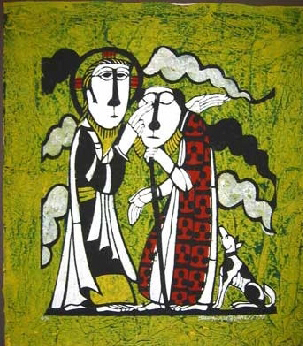
Sadao Watanabe, Christ Healing the Blind (1979).
|
Only decades later, when other scientists invented a machine that demonstrated genetic transposition, was McClintock’s work given the recognition it deserved. While she came to an understanding of genetic transposition in the 1940s and 50s, her work didn’t garner the Nobel Prize until 1983.
McClintock was deeply engaged in a profound practice of seeing that she found difficult to explain to others. When her biographer, Evelyn Fox Keller, asked her about how she did her science, she struggled to find words for her experience. She told Keller, "You somehow have to learn to lean into the kernel."
If McClintock’s method wasn’t so rooted in the banality of growing corn, we might call it mystical. But what makes it so remarkable is the way that McClintock was able to see through the visible toward the invisible. She did this not only with her eyes, but as she tried to tell Keller, with her heart.
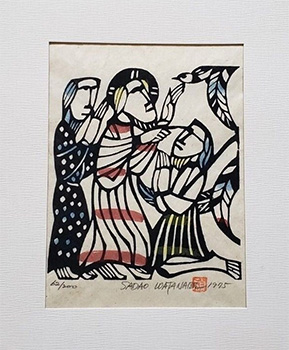
In this week’s Gospel text, Jesus encounters a man born blind. The disciples immediately want to turn him into an example in their debate about the relationship between human suffering and sin. “Who sinned, this man or his parents, that he was born blind?” (John 9:2). But Jesus is uninterested in this debate. Instead he talks about revelation, about God’s work in the world, and how it defies human understanding and our attempts to make formulas about it. Then he spits on the ground, makes mud from the dirt and his own saliva, and puts this mud on the man’s eyes. He tells the man to go and wash in the pool of Siloam.
 |
|
Sadao Watanabe, Jesus Heals a Man Born Blind (1975).
|
It is a strange miracle: intimate and messy. If you try to imagine it actually happening, you can feel the grit in the man’s eyes, the strangeness of having another person’s saliva on your eyelids. The whole thing rings of what the novelist Mary Gordon calls the “irresistible incomprehensible” in Jesus. What is irresistible is Jesus’ willingness to see the man outside of the judgments and certainties of his neighbors, the disciples, and the Pharisees. What is incomprehensible is how Jesus creates another path forward for him, outside of what we believe reality is.
After this, we watch as the implications of the miracle unfold, as people argue about its meaning and purpose, as the man repeatedly says “I don’t know” when asked how this happened. The Pharisees want to know, “How can a man who is a sinner perform such signs?” (John 9:16). They call in the formerly blind man’s parents to determine for themselves where the sin lies. They get stuck in the weeds. Did the miracle really happen? Did it happen on the Sabbath? Who observed it? Who is the person who performed the miracle? What is his status and his standing?
But the question that seems to terrify them the most is the one they don’t ask: what does this mean for us?
The Pharisees are seeing the situation the way that most of us almost always see: through our predetermined lenses, our judgments about how the world is. This is perfectly normal. Neurobiologist Semir Zeki says that because seeing humans are barraged with an overwhelming amount of visual information, we consequently “sort out relevant features and make snap judgments about what they mean.” We make random guesses about “the true nature of reality by interpreting a series of clues written in visual shorthand.”
The “visual shorthand” of everyone in this passage is sin. The world they observe is permeated with sin. If sin isn’t in the blind man himself, it must be in his parents, and if it isn’t in his parents, then obviously it is in Jesus.
 |
|
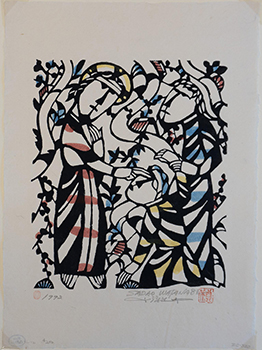
Sadao Watanabe, Jesus Healing a Blind Man (1992).
|
The man’s healing, his sight, stands as evidence against what they believe to be true about reality. In their reality, a man born blind cannot be healed, and especially cannot be healed by someone who is so obviously problematic, whose behavior is not in line with what they know of righteousness.
But the transformational seeing that both Jesus and the man born blind possess is guided not by sin, but by “seeing into the life of things” as the poet William Wordsworth put it. That is, seeing beyond this shorthanded perception of reality. The man born blind knows what it means for him. “I do not know whether he is a sinner,” he tells the Pharisees about Jesus. “One thing I do know, that though I was blind, now I see” (John 9:25).
The missing word in all 41 verses of this passage is love. Likewise, as far as I know, Barbara McClintock didn’t say that she loved corn. Later, however, her biographer drew the conclusion. “Barbara McClintock, in her relation with ears of corn, practiced the highest form of love, which is the intimacy that does not annihilate difference.”
Jesus approaches the man, not through the conditional seeing of others, but through an uninhibited and unlimited form of love; perhaps we could say an “intimacy that does not annihilate difference." Love is what enables our own ability to see beyond — outside of our snap judgments, our preconceived notion about reality — to “see into the life of things.”
Weekly Prayer
Abraham Joshua Heschel (1907-1972)
From word to word I roam, from dawn to dusk.
Dream in, dream out — I pass myself and towns,
A human satellite.I wait, am hopeful, as one who waits at the rock
For the spring to well forth and ever well on.
I feel as bright as if I tented somewhere in the Milky Way.
To urge the world to feel I walk through lonesome solitudes.All around me lightning explodes sparks from my glance
To reveal all light, unveil faces everywhere.
Godward, onward to the final weighing
overcoming heavy weight with thirst.
Constantly, the longings of all born call out, "Is anyone around?"
I know each one is HE, but in my heart there writhes a tear;
When of men and rocks and trees I hear;
All plead "Feel us"
All beg "See us"
God! Lend me your eyes!I came to be, to sow the seed of sight in the world,
To unmask the God who disguised Himself as world—
And yes, I wait to be the first to announce "The Dawn."Translated from Yiddish by Rabbi Zalman M. Schachter-Shalomi.
Abraham Joshua Heschel (1907–1972), a Polish-American rabbi, was one of the most prominent Jewish theologians of the 20th century. He was a foremost leader of the Civil Rights Movement. He was influenced deeply by Hassidic, medieval Jewish philosophy, and Kabbalah. This poem is a selection from "Human, God's Ineffable Name,” available from the Reb Zalman Legacy Project.
Amy Frykholm: amy@journeywithjesus.net
Image credits: (1) Curious Christian; (2) ebay; and (3) Weschler's Auctioneers & Appraisers.