From Our Archives
For earlier essays on this week's RCL texts, see Dan Clendenin, Who Is a God Like You? (2023); Debie Thomas, The Blessing and the Bite (2020); Dan Clendenin, Micah: Prophetic Critique and Pastoral Comfort (2017), Live Different: The Beatitudes of Jesus (2014), and The Wisdom of the World and the Foolishness of God (2011).
This Week's Essay
By Amy Frykholm, who writes the lectionary essay every week for JWJ.
Psalm 15:1: “Who may dwell on your holy hill?”
For Sunday February 1, 2026
Lectionary Readings (Revised Common Lectionary, Year A)
Psalm 15
1 Corinthians 1:18–31
Matthew 5:1–12
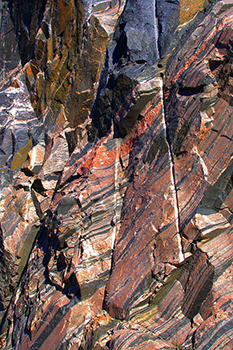
I can’t remember exactly when I fell in love with Precambrian granite. It was before I learned its name, but some time after I first saw it. On the weathered outcrops near my home, Precambrian granite is a honey-colored rock, with green and deep bronze marbling. It tumbles across hillsides and rises up in formations so evocative, it sometimes feels like they want to speak. Geologists calculate that this rock is at least four billion years old. Here on the western slope of the Mosquito Range in the Colorado Rockies, the granite has weathered into runic circular patterns that feel like a language I could learn. Deep striations and grooves tell me stories about the land around me, and I’ve longed to know more.
In her book Timefulness, geologist Marcia Bjornerud writes, “While I respect all rocks, I have a deeply instilled predilection for rocks with at least a billion years behind them. For one thing, most Precambrian rocks have survived long enough to have been caught up in at least one episode of tectonic upheaval and carried to depths far from their native habitats, then against all odds, to have found their way back to the surface.”
Precambrian rocks contain a record of the earth’s childhood, youth, and most of its adulthood — an almost inconceivable eight-ninths of the earth’s total age. Rocks do speak. “Over more than 4 billion years, in beach sand, volcanic ash, granites, and garnet schists,” Bjornerud writes in Reading the Rocks,“the planet has unintentionally kept a rich and idiosyncratic journal of its past.”
 |
|
Lyle Crump, Precambrian-aged Highly Metamorphosed Granite 1 (2022).
|
The stretches of geologic time that rocks reveal to us are frequently described as unfathomable. A fathom, in Old English, was a measure of outstretched arms. Unfathomable essentially means unmeasurable, and geologists’ efforts to measure the earth have been much trickier than you might imagine. Bjornerud explains — although to be honest I could scarcely comprehend it — that earth’s systems seem to grow as we observe them. “Ideas about size, rank, and hierarchy are being turned inside out” when we try to measure the earth. The more precise we get, the more we understand that precision is ever elusive.
When the prophet Micah makes his appeal to the mountains, he addresses these ancient beings and asks for their witness to things much smaller, younger, and more ephemeral than they are. He calls out to the “enduring foundations of the earth” to hear God’s case against God’s people (Micah 6:2).
In the Hebrew tradition, “the world is built with loving-kindness” (Psalm 89:2). In the ancient Jewish ethical and theological compilation called the Pirkei Avot, loving-kindness is called one of the three pillars on which the world stands. (Study of Torah and service to others are the other two.) The Torah mentions chesed — the Hebrew word which is only very roughly translated as loving-kindness—245 times.
Chesed endures forever (Psalm 136). Chesed, Jeremiah tells us, is what God does (9:24). God built the earth with loving-kindness, and God sustains the earth through loving-kindness. Loving-kindness, we might say, is unfathomable.
 |
|
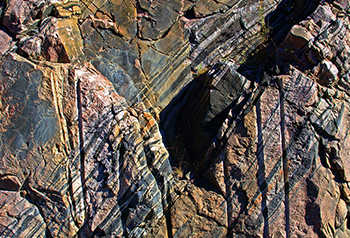
Lyle Crump, Precambrian-aged Highly Metamorphosed Granite 11 (2022).
|
For several years now, I’ve been participating in the Jewish ethical practice called Mussar. In the practice of Mussar, I choose a soul trait to focus on every week. Soul traits include things like generosity, simplicity, honor, and equanimity. I cultivate these traits in myself with practices called kabbalot — actions — that flow from that trait.
To ears trained by Mussar, the famous line in Micah 6:8, “What does the Lord require of you but to do justice, to love loving-kindness, and to walk humbly with your God?” feels like nothing less than a call to the slow work of self-transformation through this practice. Justice, loving-kindness, and humility are all soul traits important in the practice of this ethical tradition.
But loving-kindness stands out among the other traits. It’s not just one in a list. It is the very foundation on which the world rests. While it can be usefully reduced to doing simple acts of kindness in the ordinary flow of our lives, it is so much more than that. It sustains the very existence of the planet we walk on, is the “generous sustaining benevolence” (Alan Morinis in Everyday Holiness) of my own life, and speaks to the necessity of always finding ways to share that life with others.
 |
|
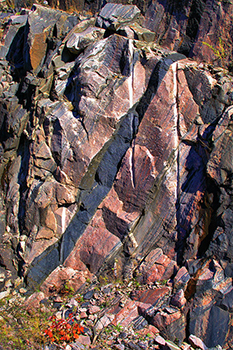
Lyle Crump, Precambrian-aged Highly Metamorphosed Granite 10 (2022).
|
Even though we think of rocks as something solid and immovable, and use them metaphorically in that way, geology teaches us this doesn’t even remotely describe them. Mountains and rocks are in constant motion — motion that is simply very slow and mostly invisible to our eyes (until of course catastrophic events like rock slides and earthquakes profoundly shift our understanding of what lies beneath us). So too is chesed a soul trait and a divine attribute that is always on the move, however plodding and minute it may seem.
When I first studied the Micah passage, I saw the change and felt the contrast from the “enduring foundations of the earth” to the ephemeral story of kings to the inner reaches of the human heart. I didn’t immediately remember who King Balak was or where Gilgal was or what these references pointed to. I thought at first only of the contrast: from the foundations to the ephemera. But as I continued to look at the passage, I saw that the through line is chesed. From geology through human history and deep into the capacities of the human heart, from the smallest actions to the grandest movements, Micah counsels us to look for the presence of loving-kindness. These examples tell us that the secret of love sits very close to upheavals, to disorientation, even very close to evil in all its forms. But chesed remains.
Weekly Prayer
Wendell Berry (b. 1934)
Geese appear high over us,
pass, and the sky closes. Abandon,
as in love or sleep, holds
them to their way, clear
in the ancient faith: what we need
is here. And we pray, not
for new earth or heaven, but to be
quiet in heart, and in eye,
clear. What we need is here.Wendell Berry (b.1934) is a Kentucky farmer, poet, and essayist, who has received honors and awards from the Guggenheim and Rockefeller Foundations, Lannan Foundation, and the National Endowment for the Arts.
Amy Frykholm: amy@journeywithjesus.net
Image credits: (1) Fine Art America; (2) Fine Art America; and (3) Fine Art America.