From Our Archives
For earlier essays on this week's RCL texts, see Dan Clendenin, Dare to Dream (2023); Debie Thomas, I Will Make You (2020); Dan Clendenin, A Radical Response to a Unique Opportunity: "They Immediately Left Everything" (2011) and Race and Repentance (2008).
This Week's Essay
By Amy Frykholm, who writes the lectionary essay every week for JWJ.
Psalm 27:8: “‘Come,’ my heart says, ‘seek God’s face!’ Your face, Lord, do I seek."
For Sunday January 25, 2026
Lectionary Readings (Revised Common Lectionary, Year A)
Psalm 27:1, 4–9
1 Corinthians 1:10–18
Matthew 4:12–23
“That’s why they don’t call it catching,” I told my son after yet another disappointing fishing adventure. He rolled his eyes. How many times had he heard that one? It didn’t really assuage the frustration. But one thing about what I said was true and I’d actually learned from my son: fishing is a form of seeking more than a form of finding.
My son was about five years old when he first became fascinated with fishing. One day when he and I were out on a hike, he spent more than an hour with a self-fashioned spear, waiting for a fish to appear in a small pond. I was amazed at his stamina and his focus. Fishing became a passion for him. He found mentors who took him out on the local river and taught him how to tie flies. He and his cousins took their fishing poles on backpacking trips and caught brookies by the dozens in high mountain lakes. On beach vacations, he spent his saved-up money not on treats and souvenirs, but on paying local fishermen to take him out on the open water.
Neither my husband nor I had any proclivity for fishing. My husband was bored by the prospect, and I would drive my son to the lake, pond, or river of his choice and bring a book to read. But I observed the way that, whether he caught fish or not, fishing shaped his life and his character, helped him build a relationship to nature, calmed his mind, and opened him to try new things.
 |
|
The Calling of Peter and Andrew by Fra Angelico, c. 1430.
|
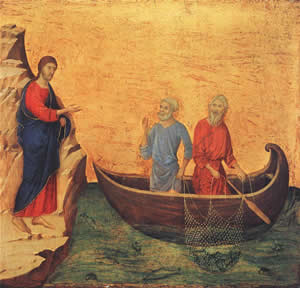
In this week’s lectionary text from Matthew, Jesus calls his first disciples — all of them fishers. Simon, Andrew, James, and John were multi-generational fishermen whom Jesus plucked directly from the shore. When Jesus approached, Simon and Andrew were “casting a net into the sea.” James and John were mending their nets. “Immediately,” the text says, they followed (Matthew 4:18–20).
In ethnobotanist Gary Nabhan’s book Jesus for Farmers and Fishers, he describes what fishing was like on the Sea of Galilee in the first century. The species the future disciples were likely fishing for was a kind of tilapia that was unique to that body of water. Nabhan describes the fish as “mildly sweet” with a flaky texture. To catch these fish, fishers would find freshwater springs within the saline water and put down their nets there.
Because of the pressure brought to bear by the Roman Empire and its desire to squeeze every last penny from the people of Galilee, the residents of that region faced one of the worst farming and fishing crises “recorded in the Western world.” The Romans were demanding new taxes, fees, tributes, rents, and tithes. They employed enforcers throughout the land, meaning that the people, especially peasants, were suffering under new forms of oppression. “Within a span of a single generation, the Galileans had seen nearly two-thirds of their annual catch at sea and their harvest from the land shunted from them in order to support the urban elite and a distant aristocracy,” Nabhan writes.
In this midst of this crisis, Jesus called his first disciples away from the waters. Why did he call fishers first? What was so special about fishing? There were other vocational domains from which the first disciples could have been called. The primary metaphor for Jesus himself is shepherd, so why weren’t the first disciples shepherds? Jesus was a carpenter, so why not carpenters? Many of Jesus’ parables were about farming, so why were those first called not farmers?
Fishing is an interesting metaphor for the call to follow Jesus. Fishing is nothing if not unpredictable. There are no guarantees, and you are subject to a large number of factors outside your control.
At the same time, fishing is a form of constant discernment. Reading the water, assessing temperature and light, noting the invertebrate food sources that are hatching. Successful fishing isn’t dumb luck. It’s a way of combining careful observation with intuition — with inner knowing.
 |
|
Duccio di Buoninsegna, The Calling of Peter
and Andrew, 1308-11, Tempera on wood panel. |
Fishing also requires patience: there’s a steadiness of focus, a willingness to come up empty, periods of long waiting without fruition. And patience is part of what makes fishing all about surprise. The “big fish” or the “big catch” come when you least expect it, often when you’ve given up hope all together. This willingness to accept the vagaries of human experience and revel in life’s surprises might have been valuable attributes in the uncertain path that Jesus was asking these fishermen to follow.
Fishing involves a fascination with what is below the surface, with where precious things might be hiding, and how we might go about finding them. It involves both familiarity and mystery. Fishing (along with many other ordinary things) is a “practice of the presence of God,” as seventeenth century monk Brother Lawrence put it.
Some of this perception and intuition is surely reflected in the fact that the future disciples respond to Jesus “immediately,” the way one immediately responds to that tug on a line or the weight in a net. Their response may have come from the fact that things had become so bad in the fishing industry that they didn’t feel they had anything to lose. But it also may have been that they saw something in Jesus that they immediately trusted and understood, a quality of relationship that spoke to them even more deeply than the waters of the sea they’d known all their lives. It may have been a wondering about this “kingdom of heaven” that Jesus said was so near.
I’d venture to say that these attributes of observation and attention, a willingness to be surprised, a trusting of our own intuition, and long patience are all attributes of the spiritual life as it is revealed to us in Jesus’ own life. If the disciples were going to be able to recognize the proximity of the kingdom of heaven, these were things they would need.
 |
|
Christ calls Peter and Andrew. Mosaic in Sant'Apollinare Nuovo, Ravenna, c. 500.
|
The tilapia that people fished for on the Sea of Galilee have a remarkable trait that is referenced in another story in Matthew 17. These fish are called “mouth-brooders”: they lay their eggs in their own mouths, then they spew the fry out when it is time for them to swim on their own. In order to prevent the fry from returning to the mouth of the adult fish, the mother picks up pebbles or other objects from the sea floor and stores them in her mouth.
When fishers brought fish in from the shore, they would habitually check the fishes’ mouths for hidden treasures. If they found such a treasure, the fishers would take it back to their village for a celebration called haflat samar, a storytelling event where among other things, they would recount the history of treasures found in fishes’ mouths over the decades and centuries.
In Matthew 17, Jesus and the disciples arrive again in Capernaum, the place where they first met. Simon (now Peter) is confronted by a tax collector, a messenger of the Roman government, demanding that Jesus pay a tax. (The Romans collected taxes on those who preached in the synagogues. Even though Jesus was mostly a street preacher, they still wanted his money.) When Peter returns to Jesus, anxious about this encounter and about his telling the tax collector that Jesus would pay the tax, Jesus tells him to go fishing. In the mouth of the first fish that he catches, he will find a coin. “Take that and give it to them for you and me,” he says (Matthew 17:27).
Even if fishing is primarily a form of seeking, the question of finding remains pertinent. When Jesus calls the fishers from the shore, he calls them from deprivation to abundance, from fear to joy, from the ordinary to the extraordinary. This is the path they are now asked to walk. Their response to Jesus’ call tells us in another way that the kingdom of heaven is near.
Weekly Prayer
Catherine of Siena (1347–1380)
We were enclosed,
O eternal Father,
within the garden of your breast.
You drew us out of your holy mind
like a flower
petaled with our soul's three powers,
and into each power
you put the whole plant,
so that they might bear fruit in your garden,
might come back to you
with the fruit you gave them.
And you would come back to the soul,
to fill her with your blessedness.
There the soul dwells —
like the fish in the sea
and the sea in the fish.Translated by Suzanne Noffke.
Catherine of Siena (1347–1380) was an Italian mystic and devout laywoman who was called a Doctor of the Church for her extensive theological scholarship. She was a counselor to two popes at a time when the church was in turmoil.
Amy Frykholm: amy@journeywithjesus.net
Image credits: (1) ArtBible.info; (2) MagicStatistics.com; and (3) Sacred-Destinations.com.