From Our Archives
For earlier essays on this week's RCL texts, see Dan Clendenin, Come and Save Us! (2022); Debie Thomas, Into the Mess (2019); Dan Clendenin, Betting on Salvation (2013) and Dreams of a Christmas Credo (2010); and Lindsey Crittenden, Who Wants to Wait? (2007).
This Week's Essay
By Amy Frykholm, who writes the lectionary essay every week for JWJ.
Isaiah 7:14: “God is with us.”
For Sunday December 21, 2025
Fourth Sunday in Advent
Lectionary Readings (Revised Common Lectionary, Year A)
Psalm 80:1–7, 17–19
Romans 1:1–7
Matthew 1:18–25
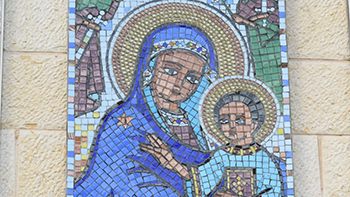
I worked for about a decade in my office before one day — in a moment of unexpected reflection — I looked up and deeply studied the woman whom I had chosen to accompany me for all those hours. It felt like the first time I’d seen her. She stared down at me with her inscrutable gaze, holding the globe in her hands: Mary, Mother of All Nations. This poster had been sent to me by Father William Hart McNichols, SJ, an artist who had done an exhibition of “Icons of the New Advent.” I’d hung it above my desk at some moment I no longer remember.
Then I’d added other Marys, as if to give her some company while I was busy doing other things, until I have become surrounded almost entirely by Marian images. Since that moment of recognition, I’ve thought many times about taking her off my wall and replacing her with images that are more of my conscious choosing. But she stays, day after day, week after week, a constant gaze. Who are you? I feel like asking her. What are you doing here? These questions continue to baffle and even surprise me.
The other day at my Episcopal church, a young man who has recently become an evangelical Christian stood in the communion circle. After the service, he took our pastor aside and pointed to the statue of the Virgin of Guadalupe that stands on the tabernacle. He wanted to know, in essence, who is she and why is she here? I think it’s fair to say that she made him uncomfortable. She represented a religion — or a way of being religious — that didn’t match his understandings. Our pastor told him that she had been put there by immigrants who found in her image comfort and solace, a sense of belonging and home. She told him that Mary stayed there to remind everyone who came in that they were being held in the love of God. He did not go away satisfied.
I wonder if Juan Diego (1474–1548) had the same questions that long ago dawn when he was, so the story goes, walking past Tepeyac Hill on his way to mass, not long after his own conversion to the Roman Catholicism of his conquerers. He was visited by a woman who told him to build a shrine to her. It took four visits and a cloak full of winter roses before Juan Diego could convince the authorities that his visions were true. Her shrine, a shrine to the Virgin of Guadalupe, remains to this day. Who is she? Why is she here?
 |
|
Our Lady (Ethiopia).
|
Even the Vatican, just a few weeks ago, felt the need to answer these questions, declaring officially that it was inappropriate to refer to Mary as “co-redemptrix” with Jesus, a title that even a pope or two has been drawn to over the centuries. They felt the need to address this doctrinal conundrum because, I think, her presence is so powerful and so ubiquitous that people could easily imagine for her a role more potent than the one she has been officially assigned.
The earliest Christian literature, however, gives us no answer to these questions and doesn’t even seem to register the slightest curiosity. The first glimpse of Mary is in the oldest Gospel, but it doesn’t come in the form of an origin story. In Mark 6, “Jesus, son of Mary” is mentioned with a cadre of named brothers and unnamed sisters.
One of the things that stands out about this passage is not who Mary is, but the fact that Mark mentions no father for Jesus. The lack of a patronym subtly brands Jesus as a person of low status, who lived in a patriarchal society without the benefit of a patriarch. “Jesus, son of Mary” is a vulnerable title. At the same time, the solitary name of Mary intrigues. Who is she? Why is she named here at all?
It wasn’t long before followers of Jesus wanted to know more. Within a few decades of Mark’s writing, stories about Mary and her now-mentioned husband Joseph came into circulation and were included in subsequent Gospels. These stories also came to occupy a significant place in apocryphal texts. From the earliest moments, people could not tell the story of Jesus without telling the stories of his mother and father. It was not enough, as perhaps Mark hoped, for people to see the man in his complicated circumstances. They needed stories of origin, of birth, of miracles. They needed to make something of that lowly status and the woman who carried Jesus in her body.
 |
|
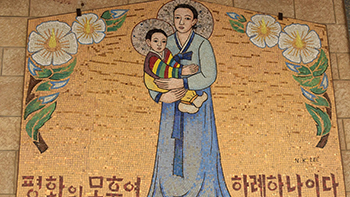
Our Lady (Korea).
|
In Mother of God: A History of the Virgin Mary, historian Miri Rubin writes that the earliest stories of Mary “are steeped in Midrashic parables — a Jewish literary tradition which elaborated biblical tales in order to elicit from them deeper meaning.” This layering of story upon story adds depth and profundity to Mary’s image and has now continued for 2000 years.
We encounter what perhaps started as one of those “Midrashic parables” in this week’s Gospel text, one of the tradition’s earliest attempts to answer questions about the identity of Mary and therefore the identity of Jesus. This week, Matthew tells the story of Jesus’s earthly father, Joseph, confronting the mystery of the Incarnation for the first time.
Tradition holds that Joseph was a carpenter, although that is not mentioned in Matthew 1. In Matthew 13, Jesus is called “the carpenter’s son,” as the people around him marvel at his tremendous wisdom and teaching. Historian Candida Moss urges us to see more clearly the lowliness of a carpenter’s position. This was not a member of the artisan class, as we’ve been taught to see it through medieval interpretations of the text.
 |
|
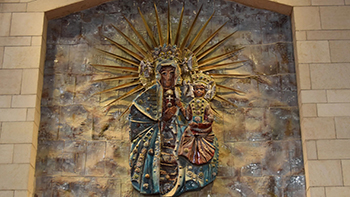
Our Lady (Poland).
|
Instead, as Moss writes in her book God’s Ghostwriters, “Carpenters, or more accurately ‘construction workers’ (the Greek noun tekton refers equally to stonemasons and bricklayers), were part of a class of marginalized workers who were often the subject of scorn and derision.” Mark 6 identifies Jesus as the carpenter; Matthew 13 identifies Joseph as the carpenter. Either way, this indicates a person of low social position.
Joseph does have the distinction, however, of being the first person recorded to find Mary’s pregnancy a scandal and a disruption. It breaks the rules. It leaves him with a series of bad choices.
Culture to culture, image to image, the dilemma of Joseph continues under the gaze of Mary, child bride, mother of the savior, Queen of Heaven. The images have familiar resonance the world over, even if they are rarely the same.
And so Mary continues to scandalize and disrupt. Her gaze continues to stare out on a world shocked by the Incarnation. And yet, she looks on us with both power and intimacy, with a love that we can’t help asking about, just as the first followers of Jesus did.
Weekly Prayer
Hildegard von Bingen (1098–1179)
Alleluia! light
burst from your untouched
womb like a flower
on the farther side
of death. The world-tree
is blossoming. Two
realms become one.Hildegard of Bingen (1098–1179) lived a life that was remarkably long and incredibly productive. Carmen Butcher has described Hildegard as an "Über-multitasking Frau" and authentic "polymath." The Benedictine abbess founded two convents, conducted four preaching tours, penned at least 400 letters, wrote music and a morality play, supervised illuminated manuscripts, cared for her fellow sisters, and wrote three major theological tomes based upon her famous visions.
Amy Frykholm: amy@journeywithjesus.net
Image credits: (1–3) Guideposts.org.