From Our Archives
For earlier essays on this week's RCL texts, see Dan Clendenin, The Ineffable Name (2023); Debie Thomas, A Lament for the Vineyard (2020); and Ron Hansen, The Vineyard (2017).
This Week's Essay
By Amy Frykholm, who writes the lectionary essay every week for JWJ.
Psalm 19:2: “Day to day pours forth speech.”
For Sunday October 4, 2026
Lectionary Readings (Revised Common Lectionary, Year A)
Psalm 19 or Psalm 80:7–15
Philippians 3:4b–14
Matthew 21:33–46
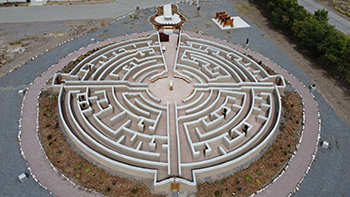
Last Saturday, a small group from my church went to the San Luis Valley in southern Colorado near the New Mexico border. We visited the newly constructed labyrinth at the oldest church in Colorado, Our Lady of Guadalupe Parish, in Conejos. Called El Santuario de Pobladores (The Sanctuary of the Settlers), it is the largest handmade adobe labyrinth in the world.
We gathered outside the labyrinth’s entrance at a picnic table and talked about what kind of spiritual practice walking a labyrinth can be. One of our members pointed to three crucial things: intention, detachment, and reverence. We come with the intention to receive guidance, we detach ourselves from outcome, and then we walk with reverence for whatever comes.
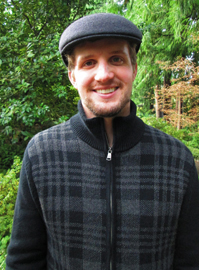
Just as we were preparing to enter the labyrinth, a pick-up truck pulled up. Alfonso Abeyta greeted us. Alfonso helped to build the labyrinth with techniques he had learned from his grandfather, participating in the making of 32,000 adobe bricks from local materials. He wanted us to see the labyrinth from the perspective of those who had migrated into the San Luis Valley from Mexico, who had made a life in this place, and whose children and grandchildren are still treasuring that inheritance.
Alfonso’s appearance seemed to have brought with it a storm, and we entered the labyrinth as thunder rumbled and rain started. That’s the way the San Luis Valley is: there’s a lot of sky. You can see storms coming from far off and watch them pass through. By the time we’d finished walking, even though we were a little damp, the storm seemed like a distant memory and the sun was shining.
 |
|
Scott Hensley, Santuario de los Pobladores (2025).
|
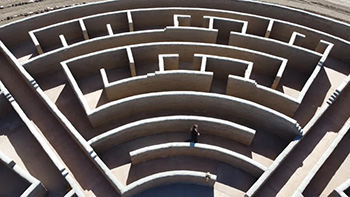
The labyrinth is organized in four sections: joyful mysteries, luminous mysteries, sorrowful mysteries, and glorious mysteries. At the end of each section, we exited into a wide center location for a pause, and then turned into the next section. As I walked, I couldn’t help but think of Alfonso. I saw the adobe construction with more educated eyes. I saw the local grasses poking out from the bricks and the way that the walls of the labyrinth got higher as we walked section to section.
But in light of this week’s gospel, the category of luminous mystery struck me the most. The luminous mysteries are the path that Jesus walked through ordinary life — and the path that we walk. Our steps, like in the labyrinth, are taken one at a time. We both feel confusion and receive guidance as we walk; we find moments of darkness and moments of illumination.
Neuroscientist Lisa Miller has spent her career studying the relationship between spiritual practice and the brain. In her recent book, The Awakened Brain, she identifies three spiritual capacities that she believes are hardwired into every human being and that we can cultivate throughout our lives: the first is the capacity to perceive that we are loved, the second is the capacity to receive guidance, and the third is the capacity to perceive that we are not alone.
In the last several years, seeking guidance for my life has become a central theme and practice for me. I no longer seek guidance only for the big picture decisions, but now in the most ordinary and basic questions of everyday life. Miller points to what she calls “a quest orientation.” A quest orientation involves the connection between a lot of different locations in the brain. There’s a “lively dialogue between thought, perception, orientation, and reflection.” As we quest — whether in daily life, on a pilgrimage, or through a deep inward searching into the self — we learn to perceive doubt as a positive aspect of life; we become increasingly open to change; we become open to seeing things with fresh eyes and expanding our perspectives.
 |
|
Kevin J. Beaty, Alfonso Abeyta (2021).
|
As we quest, we become available not only to the freshness in our own thinking, but also to messages that are hidden in life itself. Poet David Whyte talks about two kinds of help. One is visible help, and asking for this kind of help can bring incredible “buoyancy” into our lives. Whyte says that he spent an entire year asking for this kind of help every day to train himself to know that he needed it and to practice receiving it. “Oh my God,” he says, “I got so much done!”
But the other kind of help is the invisible kind, one that some religious traditions ascribe to the angelic realms. He defines this kind of help as “the help you don’t yet know you need.” You have to pay very close attention in order to receive this kind of help, and yet it is around us all the time. He proposes that, in our daily lives, we ask, “What essential help is walking past me right now?”
This is the luminous mystery. Asking for help and looking for guidance can be difficult. We resist the wisdom that’s available to us all around in sources outside ourselves. I remember the shock I felt the first time someone suggested that God’s voice might be in the mouth of another person. We were in the midst of some difficult discernment at a committee meeting in church. “Listen closely,” this person said, “because God might speak through someone in the room.” I’d only ever thought of the voice of God as some kind of inner whisper. It hadn’t occurred to me to think that the guidance we were seeking might actually come from someone’s voice in the very room we were in. I began to listen differently after that.
One way to look at the parable of the landowner and the tenants of the vineyard in Matthew 21 is as a commentary on our lack of willingness to receive guidance, visible and invisible. Seen this way, this dark and violent story becomes both tragic and humorous: we observe the stubbornness in the tenants as a stubbornness in ourselves. The landowner sends messenger after messenger to the tenants, and each messenger is so thoroughly rejected that he is beaten, stoned, and killed in turn. We are all living on an earth that we do not own; we are all wary of help that appears to come from outside; we all want to hoard what was never ours in the first place.
 |
|
Scott Hensley, Inside the Labyrinth (2025).
|
What if the tenants had seen these messengers not as threats, but as forms of hidden help? What if they had been able to listen to them? The bad news is that we have a tendency not to listen. The good news is that God keeps sending ever-more beloved messengers to our aid.
Our capacity to receive guidance requires practice in humility, intention, and a willingness to receive. Guidance helps us to live creatively and resourcefully — we are open to the possibility that life might reveal itself to us. Life almost always has more meaning than we can perceive at any one moment — more mystery, more joy, more sorrow, more luminosity, and more glory.
We pilgrims returned home exhausted and yet somehow also more alive. We’d spent the day watching clouds, encountering strange angels, opening ourselves to new experiences, and pondering ancient mysteries. Each careful step we had taken in the labyrinth now had the opportunity to reverberate in our everyday lives. I had a sense that we had walked inwardly as well as outwardly, and that the guidance we’d received was as luminous as it was ordinary.
Weekly Prayer
Rainer Maria Rilke (1875-1926)
Only in our doing can we grasp you.
Only with our hands can we illumine you.
The mind is but a visitor:
it thinks us out of the world.Each mind fabricates itself.
We sense its limits, or we have made them.
And just when we would flee them, you come
and make of yourself an offering.I don’t want to think a place for you.
Speak to me from everywhere.
Your Gospel can be comprehended
without looking for its source.When I go toward you
It is with my whole life.Translated from German by Anita Barrows and Joanna Macy.
Rainer Maria Rilke (1875–1926) was an Austrian poet who from a very early age knew that his life was meant for literature, poetry, and writing. A frequent theme of Rilke’s poetry, Annemarie Kidder remarks, "is the human heart's insatiable longing for the transcendent, the divine," which expressed itself in religious proclivities that were decidedly unorthodox. This poem can be found in Book of Hours: Love Poems to God (Riverhead, 2005), 51.
Amy Frykholm: amy@journeywithjesus.net
Image credits: (1) World-Wide Labyrinth Locator; (2) Colorado Public Radio; and (3) Atlas Obscura.