From Our Archives
For earlier essays on this week's RCL texts, see Michael Fitzpatrick, There You Will See Me (2023); Debie Thomas, Risen (2020); Sara Miles, How to Be an Evangelist (2017); Ron Hansen, "Death, Thou Shalt Die" (2014); and Rebecca Lyman, "Ours the Cross, the Grave, the Skies" (2011).
This Week's Essay
By Amy Frykholm, who writes the lectionary essay every week for JWJ.
Colossians 3:2: “Set your minds on things that are above.”
For Sunday April 5, 2026
Lectionary Readings (Revised Common Lectionary, Year A)
Psalm 118:1–2, 14–24
Colossians 3:1–4 or Acts 10:34–43
John 20:1–18 or Matthew 28:1–10
Several years ago I became fascinated by the story of Kevin Jorgesen. He is a rock climber who, along with fellow climber Tommy Caldwell, attempted the first ever free climb of the Dawn Wall of El Capitan in Yosemite National Park. Free climbing is an activity — later made famous by Alex Hannold and the film Free Solo — in which a person attempts to climb a rock face using no ropes, harnesses, or fixed anchors, but only the small finger and toe holds found naturally in the rock. While the route is broadly predetermined, the intricacies of the vertical passage must be puzzled out pitch by pitch, climber by climber. Forging ahead on his own, Caldwell navigated his way to the top on December 28, 2014. But Jorgensen remained on the mountain wall for ten more days — his nights spent on a narrow ledge, his days spent trying to rediscover the hidden path his partner had seen, or finding some other route up.
In a way, I waited with him. I tried to imagine what it was like for him out there on that rock shelf, waiting every night for the sun to come up so that he could try again. I counted the nights and thought that surely he would give up. Send for the helicopter; try again next year. I was amazed that every day he stayed and tried again. And then one day, for no easily explicable reason, something inside him changed, maybe something in his sight adjusted, or his minute exploration of the rock finally bore fruit, and he climbed to the top.
I was riveted by his journey and profoundly moved, not least because I couldn’t see in myself what I saw in him: the patience to wait while the path forward unfolded. I knew for a fact I would have given up. In the days following his ascent, I wrote Jorgensen a letter in the form of a poem.
Ascent of the Dawn Wall
I watched you read the language of granite
with your fingertips,
bloodied and superglued,
until the rock’s mystery denied you passage.On that face of cold mineral,
face of razored braille.Day three. Day seven. Day ten.
Did you sleep with despair? Wake
with it, watch with it as
Dawn crept again over the canyon walls?I might have preferred despair’s hot fingers
to the rock’s unyielding surface.But you. You.
You choseto explore with your wounds
one more touch of the beloved’s face.Like all things worth doing,
you searched at another sunrise
for an opening in even that rock.
I’ve always been grateful that the Gospels’ accounts of the resurrection take place at sunrise. Easter services in general are a little too loud for me. Trumpets and lilies and pastel Easter colors. Something inside me shrinks at the noise, and if I am honest, at the joy. Am I ready to feel joyful? If not, am I expected to put on a show?
 |
|
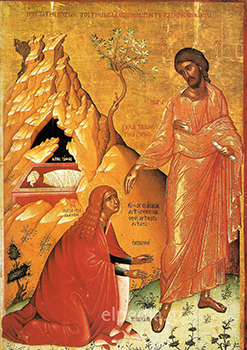
Cretan Icon, Noli Me Tangere (16th c.).
|
I love the starkness of Lent, and I generally feel some grief when it’s over. I love how I’m being asked to strip away layers of falseness, scrape at whatever has become too much. I have trouble moving on; I have difficulty allowing something new to stir inside me.
So I have to sneak up on Easter. There’s something profoundly comforting for me that Mary Magdalene arrives at the tomb while it is still dark. I can feel the stillness. I can feel that moment before sunrise and before she knows about the resurrection. I feel available to surprise and wonder. But later, I feel like I’m staring at an impenetrable rock face, a hot desert sun glancing off it, with no way into the demands of Easter.
The sun is high in the sky by the time Mary has gone back to tell the disciples the news of Jesus’ missing body. She now returns, by herself, to confront the facts.
When Jesus approaches her, she does not recognize him. He acts as if he does not know her. “Woman,” he calls her, and pauses for what seems an indifferent, if not cruel, moment — allowing her to feel her pain and ask for what she seeks. Only then does he speak her name, “Mary,” and suddenly she recognizes and is recognized at the very same moment.
In his book A Mystical Portrait of Jesus, Demetrius Dunn notes that in the Gospel of John, “revelation of divine presence” doesn’t happen through “an impersonal exchange of information,” but through “a mystical experience of loving recognition.” Jesus’ resurrected presence is known in this loving exchange, in the love that passes between himself and Mary.
Another way of saying this is perhaps that resurrection isn’t a proposition to be believed in, but is a condition to be felt. Every Easter morning, I’m always seeking something inside myself that will consent to feeling it.
 |
|
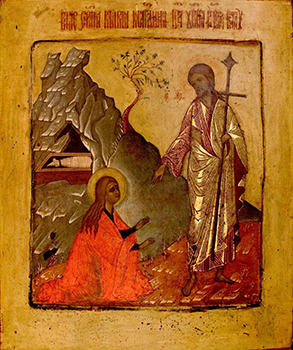
Anonymous, Noli Me Tangere (no date).
|
But then Jesus directs some harsh words at Mary: “Do not touch me.” The passage is also translated as “Do not cling to me” and “Do not hold on to me.” The iconographer Mary Green calls these “stark” words. Jesus has just arrived, and he’s already on his way out. The relationship that Mary and Jesus had before is no longer the relationship that is possible now. Jesus and Mary used to relate human being to human being, but now they are both changed and they have to find a new path forward. When Jesus says, “Do not touch me because I have not yet ascended to the Father,” he is speaking into a mystery that is beyond Mary’s reach.
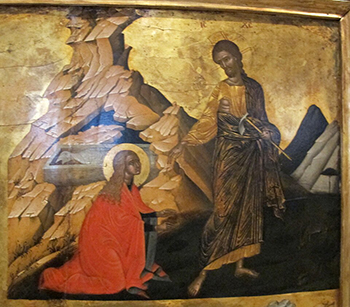
In the icon traditionally titled Noli Me Tangere (Don’t Touch Me, in Latin), Mary is kneeling, and she reaches toward the risen Jesus, but her hand does not reach his cloak. Standing, he holds out a hand toward her, but likewise does not touch her face. Behind her is a mountainside, and revealed within it are the burial clothes that once held the dead body of Jesus. The mountainside is steep and precarious with step-like stones embedded in it, suggesting that the path of resurrection is also steep and precarious, and yet we are asked to climb it.
Jesus’ words seem to demand that Mary learn right away what her attachments are. She must investigate what she clings to, because whatever it is will never be God. This path of resurrection is a scramble. The slope is steep. The handholds few. You might be staring at the face of a rock for days before you find the way both inside yourself and outside yourself to go forward. It is a demanding lesson to be learned right away, in those first few moments of living the resurrection.
 |
|
Greek Icon, Noli Me Tangere (16th c.).
|
As Mary Green, the iconographer, meditated on this traditional icon, she writes that she came to hear Jesus saying, “Do not cling to me just now. I am on my way to the Father…I cannot be the redeemer for one if I cannot be the redeemer for all…I am not a captive god. Get over the individualistic idolatry of exclusivity. Do not confine me as your ‘personal savior’…Do not cling to your little phrases and cliches that you believe to be faith that you think are trust in me. Do not cling to me until you face the grace of the climb.”
Jesus’ words, “Do not cling to me,” come very quickly following the resurrection. Jesus gives Mary barely a moment to contemplate his resurrection before he insists that she let him go. This must mean, at least in part, that meeting Jesus at the tomb is not the end of the story. It’s the very beginning. Resurrection is not a return to what was, but is a remarkable new reality that will have to be lived differently. Essential to that new reality is the process of letting go.
Weekly Prayer
Rainer Maria Rilke (1875-1926)
I Believe in All That Has Never Yet Been Spoken
I believe in all that has never yet been spoken.
I want to free what waits within me
so that what no one has dared to wish formay for once spring clear
without my contriving.If this is arrogant, God, forgive me,
but this is what I need to say.
May what I do flow from me like a river,
no forcing and no holding back,
the way it is with children.Then in these swelling and ebbing currents,
these deepening tides moving out, returning,
I will sing you as no one ever has,streaming through widening channels
into the open sea.Translated by Joanna Macy.
Rainer Maria Rilke (1875-1926) was an Austrian poet who from a very early age knew that his life was meant for literature, poetry, and writing. A frequent theme of Rilke’s poetry, Annemarie Kidder remarks, "is the human heart's insatiable longing for the transcendent, the divine," which expressed itself in religious proclivities that were decidedly unorthodox. This poem can be found in Book of Hours: Love Poems to God (Riverhead, 2005), p.65.
Amy Frykholm: amy@journeywithjesus.net
Image credits: (1) Elpedia; (2) Wikimedia.org; and (3) Wikimedia.org.