|
The Journey Without, The Journey Within:
Ignorance, Inclusion, and Impotence
For Sunday June 8, 2008
Lectionary
Readings (Revised Common Lectionary, Year A)
Genesis 12:1–9
or Hosea 5:15–6:6
Psalm 33:1–12
or 50:7–15
Romans
4:13–25
Matthew 9:9–13,
18–26
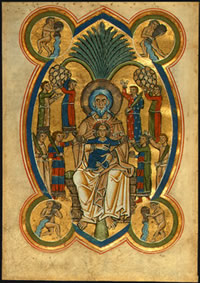 |
Paradise with Christ in the lap of Abraham, 13th century Germany. |
4,000 years ago a family of semitic nomads left Ur of the Chaldeans, perhaps in southeastern Iraq near Nasariyah, and settled in Haran, Turkey, on the Syrian border. In Haran the father Terah died. His son Abraham received a divine command to continue his journey: "Leave your country, your people, and your father's household and go to the land I will show you" (Genesis 12:1).
Believing that he had heard the very voice of God, at the age of seventy-five "Abram left, as the Lord had told him" (Genesis 12:4). He couldn't have known it at the time, but when he left his home, he altered human history ever after.
Abraham left in faith, not knowing where he was going, or even why he was going, except that God had commanded him. He defied both the inner propensities of human nature and the outer pressures of cultural conformity that call us in the opposite direction. We like to journey from the unknown to the known. We want to move from what we do not have to what we think we want and need, away from the strange and the unpredictable and toward the safe and the secure. Unsatisfied with mere promises, we demand absolute guarantees. While we demand clarity and act timidly, Abraham acted whole-heartedly without absolute certainty.
The story of God's call upon Abraham's life is a call that's repeated to each one of us today. This Abrahamic call from God subverts conventional wisdom, and so it can feel counter-intuitive. It's a call to move beyond three deeply human and unusually powerful fears — fear of the unknown that we can't control (ignorance), fear of others who are different from us (inclusion), and fear of powerlessness in the face of impossibilities (impotence).
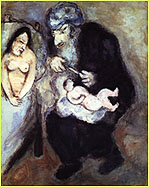 |
God covenants to make Abraham a father of many nations, Marc Chagall, 1931. |
First, God called Abraham to leave his geographic place and everything that was familiar to him: "Leave your country, your people and your father's household and go to the land I will show you" (12:1). So Abraham gathered his family and possessions, left Haran, and "set out for the land of Canaan." This story, though, is about more than a change of geography, for the longest and hardest journey is not the journey without but the journey within. However daunting and strange Abraham found the geography of ancient Canaan, it paled in comparison to the geography of his human heart.
When he left Haran for Canaan, Abraham left all that was familiar — all custom and comfort, family and friends, all regularity and rhythm of his life. The only thing he retained of his homeland in Haran was the power of memory. His journey moved from present clarity into a future of genuine and profound ignorance. Abraham journeyed from what he had to what he did not have, from the known to the unknown, from everything that was familiar to all things strange. Thus the New Testament commends his subversive obedience to God: "By faith Abraham, when called to go to a place he would later receive as his inheritance, obeyed and went, even though he did not know where he was going. By faith he made his home in the promised land like a stranger in a foreign country" (Hebrews 11:8–9).
In his journey into the unknown, Abraham embraced his ignorance. He relinquished control. He chose to trust God's promise to bless him in a new and strange place. But this required a second choice on his part. He had to leave not only his geographic place. He had to leave behind his narrow-minded, small-minded, parochial vision, the tendency in all of us to exclude the strange and the stranger. God gave a staggering promise to this obscure, Semitic nomad: in response to his obedience God would make him the heir of all the world.
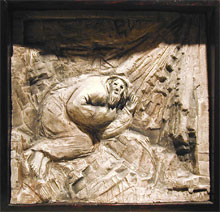 |
The call of Abraham, ceramic relief by Richard McBee, 1980. |
Notice the simultaneous narrowing and expansion of God's action in human history, a movement from the particular to the universal. God called a single individual, Abraham, and promised that he would inherit the entire earth. There's a progressive expansion in God's promise. God vowed to make of him a "great nation." Paul describes Abraham as a father of "many nations" (Romans 4:17 = Genesis 17:5). Genesis says that "all peoples on earth will be blessed through you" (12:3). Once again, the New Testament commentary elucidates this Old Testament story. Through this one man, and the one nation Israel, God made Abraham "the father of us all" (Romans 4:16–17). In one particular person God embraced all humanity.
Our common tendency is to fear the other, to suspect and marginalize the strange, to dismiss all that's different from who and what we know. But God called Abraham and now us to a universal and inclusive embrace of everyone and "all peoples on earth." In Romans 3:29 Paul asked a provocative rhetorical question: is God the God of Jews only? Jews, of course, identify Abraham as their founding father, Christians trace the lineage of Jesus Christ back to him (Matthew 1:1), and Muslims revere him as a friend of God, a father of the prophets, and an ancestor of Mohammed (Koran 37:109). In his singular journey, then, Abraham instigated blessings to the world.
There was one problem about God's promise of progeny to bless the entire world through a single individual who in obedience journeyed into the unknown. Abraham and his wife Sarah were both about seventy-five years old (Genesis 12:4). They didn't have our knowledge of the biology of human reproduction, but they knew that they were beyond their child-bearing years. Humanly-speaking, they faced an impossibility that brought them face to face with their own powerlessness to alter their circumstances. Biologically-speaking, barren Sarah and impotent Abraham were "as good as dead" (Hebrews 11:12). At first both Abraham and Sarah scoffed at the idea that she would bear a child and become "the mother of nations" (Genesis 17:16, 17; 18:12).
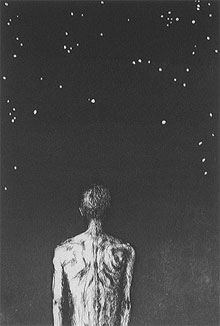 |
Your descendants will be as numerous as the stars, Genesis 22:17. |
But God rebuked them: "Is anything too hard for the Lord?" (18:14). And so Abraham made a counter-intuitive and subversive choice; he believed that God had the power to perform what He had promised. He trusted that God is a God who "gives life to the dead and calls things that are not as though they were" (Romans 4:17, 21). That is to say, Abraham moved beyond his fear of powerlessness to faith that God could, quite literally, make something out of nothing. After a few false starts that included chronic lying about his wife and bearing children by his slave Hagar, Isaac, the son of promise, was born.
When God called him, Abraham subverted conventional wisdom and moved beyond understandable human fears — ignorance, inclusion, and impotence. Instead of lamenting his ignorance and the loss of control, he embarked upon a journey into the unknown. Instead of fearing inclusion of the strange and the outsider, he gave himself to God's promise of a universal blessings for the whole earth. In the face of his own profound impotence, he believed that God could do the impossible. In doing so, he became "the father of us all."
For further reflection
* How does the journey metaphor speak to you?
* Where are you on your spiritual journey?
* Which of Abraham's three challenges resonates with you — ignorance, inclusion, or impotence?
* Reflect on the truth that God "gives life to the dead and calls things that are not as though they were" (Romans 4:17, 21).
* Meditate: "By faith Abraham, when called to go to a place he would later receive as his inheritance, obeyed and went, even though he did not know where he was going. By faith he made his home in the promised land like a stranger in a foreign country" (Hebrews 11:8–9).
Image credits: (1) National Gallery of Art; (2) Time.com: Genesis Reconsidered; (3) Richard McBee; and (4) Galerie Jean-Marc Laik.